
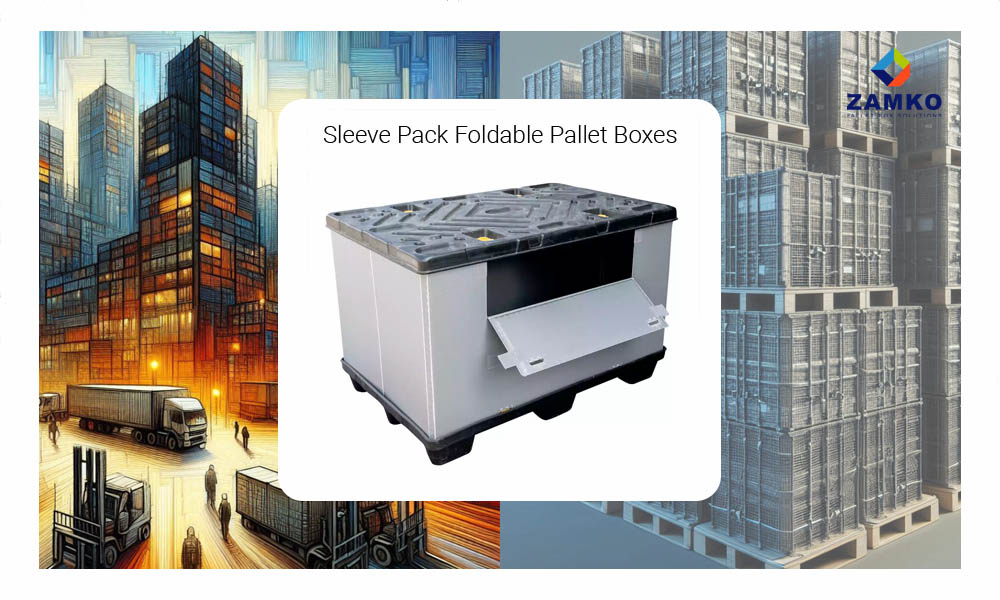
De werkelijke kosten van een sleeve pack zijn niet de aankoopprijs
De meeste inkopers beginnen met de vraag: wat kost een sleeve pack? Dat is de verkeerde vraag. Dit artikel ondersteunt de bredere sleeve pack systemen gids door uitsluitend te focussen op kosten, total cost of ownership en procurement economics.
Een sleeve pack van €100 die over vijf jaar 130 cycli maakt, heeft een afschrijvingskost van €0,77 per cyclus. Een eenmalige kartonnen palletbox van €14 die één keer wordt gebruikt, kost €14,00 per cyclus - meer dan 18 keer zoveel alleen op afschrijving.
Maar afschrijving is slechts een deel van het verhaal. Wanneer u retourtransport, handling, schade, reiniging en afvoer meerekent, komt de volledige kost per cyclus voor eenmalig karton uit op €16,68, tegenover €4,93 voor een sleeve pack - een besparing van €11,75 per cyclus, elke cyclus opnieuw, gedurende de volledige levensduur van de vloot.
Deze gids geeft u het rekenkader om uw eigen cijfers door te rekenen en laat zien waarom optimaliseren op aankoopprijs alleen in een gesloten retourlogistiek systeem juist tot de hoogste totale kosten kan leiden.
Waarom inkoopteams vaak de verkeerde verpakking kiezen
De meeste verpakkingsbeslissingen beginnen met een vergelijking van offertes. Een inkoper ontvangt meerdere prijzen en vergelijkt de stukprijs van elke verpakkingsoplossing. Dat is begrijpelijk, maar deze aanpak negeert vaak de kosten die ontstaan nadat de verpakking op locatie is aangekomen.
In veel supply chains vertegenwoordigt de aankoopprijs slechts een fractie van de totale kosten. Retourtransport, handling, reiniging, reparaties, magazijnopslag, afvalverwerking en productschade kunnen gedurende de levensduur van een verpakkingssysteem gemakkelijk hoger uitvallen dan de initiële investering.
Bij eenmalige verpakking liggen aankoopprijs en levenscycluskosten vaak dicht bij elkaar, omdat de verpakking maar één keer wordt gebruikt. Bij herbruikbare verpakking ligt dat anders. Een hogere aankoopprijs kan leiden tot een lagere kost per zending wanneer de verpakking langer meegaat, efficiënter inklapt voor retourtransport of handling- en schadekosten verlaagt.
Daarom vergelijken ervaren inkoopteams verpakkingssystemen steeds vaker op kosten per cyclus in plaats van op aankoopprijs alleen.
Een praktisch evaluatiekader voor inkoop
Bij het vergelijken van herbruikbare verpakkingssystemen moeten inkoopteams meerdere kostendrijvers tegelijk beoordelen, in plaats van uitsluitend naar de aanschafkosten te kijken.
De belangrijkste factoren zijn meestal:
- Kosten per verzendcyclus
- Verwachte levensduur
- Efficiëntie van retourtransport
- Productbescherming
- Repareerbaarheid en onderhoudsbehoefte
Deze factoren beïnvloeden elkaar. Een verpakkingssysteem met een hogere aankoopprijs kan een lagere levenscycluskost behalen wanneer het langer meegaat, efficiënter inklapt voor retourtransport, productschade verlaagt of minder vervangingen vraagt tijdens gebruik.
Daarom beoordelen ervaren kopers verpakking steeds vaker met Total Cost of Ownership (TCO) in plaats van met de stukprijs alleen.
Totale kost per cyclus: sleeve pack versus eenmalig karton
Gebaseerd op een realistisch Europees gesloten retourscenario: tweewekelijkse zendingen (26 cycli/jaar), sleeve pack van €100, levensduur van 5 jaar (130 totale cycli), retourlus van 400 km, €350/truck FTL-tarief en €35/u arbeidskosten.
Kostenelement | Sleeve pack / cyclus | Eenmalig karton / cyclus | Berekeningsbasis |
Afschrijving | EUR 0.77 | EUR 14.00 | Sleeve pack: EUR 100 / 130 cycles. Cardboard: EUR 14 per unit, 1 cycle. |
Uitgaand transport | EUR 0.40 | EUR 0.40 | Equal – same loaded truck and same footprint. |
Retourtransport (leeg) | EUR 1.35 | EUR 0.00 | Sleeve pack: 260 collapsed units per curtainsider at EUR 350/truck. Cardboard: disposed on-site. |
Handling en arbeid | EUR 1.75 | EUR 0.88 | Sleeve pack: 3 min at EUR 35/hr. Cardboard: 1.5 min at EUR 35/hr. |
Reiniging | EUR 0.16 | EUR 0.00 | Pressure wash every 50 cycles at EUR 8/wash. |
Schade en claims | EUR 0.15 | EUR 0.80 | Closed walls reduce many handling and transit damage risks. |
Reparatie / vervanging | EUR 0.35 | EUR 0.00 | Approx. 10% of fleet needs sleeve or lid replacement/year at avg. EUR 35/part. |
Afvoer / afval | EUR 0.00 | EUR 0.60 | Cardboard collection, baling or landfill at approx. EUR 0.60/unit. |
TOTALE kosten per cyclus | EUR 4.93 | EUR 16.68 | Saving: EUR 11.75 per cycle. |
Jaarlijkse kosten per sleeve pack (26 cycli) | EUR 128.18 | EUR 433.68 | Annual saving per sleeve pack: EUR 305.50. |
Bronopmerking: de vrachttariefaannames zijn gebaseerd op Europese FTL-benchmarklogica. Het arbeidstarief van €35/u weerspiegelt typische Europese industriële magazijnkosten. Pas alle cijfers aan op uw eigen route, loonniveau, beladingsdichtheid en schadepercentage.
Wanneer Total Cost of Ownership het belangrijkst is
Het belang van Total Cost of Ownership hangt vooral af van hoe vaak verpakking opnieuw wordt gebruikt.
Logistiek scenario | Belang van TCO-analyse |
Eenmalige exportzending | Laag |
Incidentele zendingen (1-4 cycli/jaar) | Medium |
Maandelijkse gesloten retourzendingen | Hoog |
Wekelijkse gesloten retourzendingen | Zeer hoog |
Dagelijkse shuttle-loops tussen fabrieken | Kritisch |
Een sleeve pack die zes keer per jaar wordt gebruikt, gedraagt zich economisch heel anders dan een sleeve pack die tweeënvijftig keer per jaar wordt gebruikt. Hoewel de aanschafkosten identiek blijven, verschilt de kost per verzendcyclus sterk omdat de investering over veel meer gebruiksmomenten wordt verdeeld.
Naarmate de cyclifrequentie stijgt, worden factoren zoals vouwratio, repareerbaarheid, levensduur en efficiëntie van retourtransport steeds belangrijker. In veel hoogfrequente logistieke lussen hebben deze factoren meer invloed op de totale kosten dan de oorspronkelijke aankoopprijs.
Terugverdientijd en rendement over 5 jaar
Bij een aankoopprijs van €100 en een jaarlijkse besparing van €305,50 per sleeve pack bedraagt de terugverdientijd 3,9 maanden. Dat is de periode waarin elke sleeve pack meer bespaart dan hij kostte om aan te schaffen.
Over 5 jaar en 130 totale cycli bedraagt het nettorendement €1.427,50 per sleeve pack na aftrek van de aankoopkosten - een rendement op investering van 1.428%.
De cyclifrequentie verandert de jaarlijkse besparing, maar niet de besparing per cyclus van €11,75:
Verzendfrequentie | Jaarlijkse besparing per sleeve pack systeem | Terugverdientijd |
Maandelijks (13 cycli/jaar) | EUR 153 | 7,9 maanden |
Tweewekelijks (26 cycli/jaar) | EUR 306 | 3,9 maanden |
Wekelijks (52 cycli/jaar) | EUR 611 | 2,0 maanden |
Dagelijks (260 cycli/jaar) | EUR 3,055 | < 1 maanden |
Voor bredere procurement-context over meerdere herbruikbare verpakkingssystemen, zie de inkoopgids voor herbruikbare verpakking.
Belangrijkste strategieën om totale sleeve pack kosten te verlagen
Zodra u accepteert dat de aankoopprijs slechts één kostenelement is, worden de echte optimalisatiehefbomen duidelijker:
- Koop per volle containerlading - bulkprijzen verlagen de stukprijs vaak met 10-20%.
- Stem afmetingen af op stellingen en goederen - verkeerde maten veroorzaken loze ruimte en onnodige handlingkosten.
- Selecteer alleen essentiële opties - sluitingen, aangepaste kleuren en bedrukking verhogen de kosten.
- Kies de juiste laadcapaciteit - overspecificatie voegt materiaalkosten toe met beperkte operationele waarde.
- Overweeg kwalitatieve gebruikte sleeve packs wanneer de toepassing dat toelaat - goede gebruikte units kunnen de aanschafkosten aanzienlijk verlagen.
Hoe verpakkingsspecificatie de totale kosten beïnvloedt
De juiste sleeve pack specificatie kiezen is niet alleen een technische beslissing. Ze beïnvloedt ook de levenscycluskosten.
A common mistake is to over-specify the packaging. Higher load capacities, additional options, custom colours, special closure systems and premium materials all increase acquisition cost. In many operations these additional features provide little practical benefit.
Procurement teams should focus on the requirements that genuinely influence operational performance:
- load capacity
- handling method
- storage and racking requirements
- return transport efficiency
- expected service life
The objective is not to purchase the most sophisticated sleeve pack, but to identify the specification that delivers the lowest total cost over the expected number of shipment cycles.
Economic and Environmental Benefits
Reusable packaging such as sleeve pack boxes can deliver both financial and environmental performance when the logistics loop is suitable.
- High-quality sleeve packs can remain in service for many years and hundreds of cycles, which reduces depreciation per shipment.
- Each reusable container can replace large numbers of single-use boxes over its service life.
- Circular packaging systems are increasingly relevant for ESG and CSRD reporting when cycle data, repair history and end-of-life handling are documented.
For a deeper environmental view, see the lifecycle analysis of sleeve packs.
Common Procurement Mistakes When Comparing Packaging Costs
Many packaging purchasing decisions are made under time pressure. As a result, procurement teams often focus on the figures that are easiest to compare: supplier quotations and unit prices. While understandable, this approach can create misleading conclusions.
The most common mistake is comparing the purchase price of different packaging systems without comparing their expected cost per shipment cycle. A sleeve pack costing EUR 100 may initially appear expensive compared to a one-way solution costing EUR 14. However, if the sleeve pack completes more than one hundred cycles during its service life, the acquisition cost becomes only a small component of the total cost.
Another common mistake is ignoring return transport economics. The ability to collapse sleeve packs significantly reduces empty transport volume, which can have a larger impact on lifecycle cost than the initial purchase price itself.
Procurement teams also frequently over-specify packaging. Higher load capacities, additional options, custom colours and specialised features increase acquisition cost without necessarily improving operational performance.
Hidden Cost Drivers That Are Often Ignored
Most packaging cost calculations include purchase price and transport cost. Far fewer include the secondary costs that accumulate throughout the life of a packaging system.
Cost driver | Frequently included in cost calculations? |
Purchase price | Usually |
Uitgaand transport | Usually |
Transport terug | Sometimes |
Productschade | Sometimes |
Warehouse handling | Rarely |
Reiniging | Rarely |
Repairs | Rarely |
Disposal costs | Rarely |
Storage space utilisation | Rarely |
Individually, these cost elements may appear relatively small. Over dozens of shipment cycles, however, they can materially influence the economics of a packaging system.
For a broader explanation of logistics cost reduction through reusable packaging, see how returnable transport packaging reduces logistics costs.
Why Packaging Cost Models Often Underestimate Reusable Systems
Many packaging evaluations are built around annual purchasing budgets. This naturally emphasises acquisition cost because it is visible immediately.
Reusable packaging behaves differently. The investment occurs upfront, while many of the benefits are realised gradually over years of operation. As a result, traditional cost models often underestimate the economic value of reusable systems.
For example, lower damage rates may reduce product losses. Better folding ratios may reduce return transport costs. Longer service life may spread acquisition cost over hundreds of shipment cycles. These benefits rarely appear on the original supplier quotation, yet they can have a significant impact on total cost.
This does not mean reusable packaging is always the correct choice. It means that evaluations should consider both acquisition cost and lifecycle performance before comparing alternatives.
Example: Evaluating a Typical Automotive Logistics Loop
Consider an automotive supplier shipping components between two production locations twenty-six times per year.
The supplier compares a sleeve pack costing EUR 100 with a one-way cardboard alternative costing EUR 14 per shipment. At first glance, the cardboard solution appears less expensive. However, after accounting for lifecycle cost, return transport efficiency, handling, damage reduction and service life, the economics change significantly.
Using the assumptions presented in this guide, the sleeve pack generates approximately EUR 306 in annual savings while achieving payback in less than four months.
For a real-world logistics example, see the Bulgarian automotive supplier case study.
Why Different Industries Reach Different Conclusions
Packaging economics are rarely universal. The same packaging system can produce very different results depending on the characteristics of the supply chain.
In automotive logistics, high shipment frequency often makes lifecycle cost the dominant decision factor. In beverage packaging, transport density and storage efficiency may play a larger role. For PET preforms and bottle caps, lightweight but high-volume products create a strong focus on cube utilisation and return transport efficiency.
Similarly, industries handling heavy industrial components may place greater emphasis on load capacity and durability than on folding efficiency.
This is why two companies evaluating the same sleeve pack may arrive at different conclusions. The correct packaging decision depends not only on the container itself, but also on shipment frequency, transport distance, return logistics, handling requirements and the nature of the product being transported.
When Sleeve Packs Are Not the Best Choice
Sleeve packs can deliver substantial savings in many closed-loop supply chains, but they are not the best solution for every application.
Situatie | Alternative worth considering |
One-way export shipments | Cardboard pallet boxes |
Very low shipment frequency | One-way packaging |
Heavy products or high point loads | Gaascontainers |
Short-term projects | Rental or short-term hire |
Applications requiring limited protection | Simpler transport packaging |
Products with very high weights or concentrated point loads may be better suited to palletkooien van gaasdraad, which are designed for demanding industrial handling environments.
The objective should never be to select sleeve packs by default. The objective is to identify the packaging system that delivers the lowest total cost and the best operational fit for the specific logistics process.
What Experienced Procurement Teams Learn Over Time
Companies that are new to reusable packaging often focus on acquisition cost. This is understandable because purchase price is the easiest figure to compare between suppliers.
However, organisations that have operated returnable packaging systems for several years typically evaluate packaging differently. Their attention gradually shifts from purchase price to cost per cycle, return transport efficiency, service life, repairability and operational performance.
In many mature returnable packaging operations, the difference between a EUR 90 and a EUR 110 sleeve pack becomes relatively insignificant compared to the long-term impact of transport costs, handling efficiency, damage reduction and lifespan.
Experienced procurement teams therefore tend to ask different questions:
- How many cycles can the packaging realistically achieve?
- What is the expected cost per cycle?
- How efficiently can empty packaging be returned?
- How easily can damaged components be repaired or replaced?
- How does the packaging influence warehouse and transport operations?
This shift in perspective explains why companies operating high-frequency logistics loops often evaluate packaging systems using lifecycle economics rather than acquisition cost alone.
Why Cost Per Cycle Matters More Than Unit Cost
A common mistake when evaluating packaging is comparing unit prices without considering how often the packaging will be used.
In the example used throughout this guide, a EUR 100 sleeve pack completing 130 shipment cycles has an acquisition cost of approximately EUR 0.77 per cycle.
By comparison, a cardboard pallet box costing EUR 14 and used once has an acquisition cost of EUR 14.00 per cycle.
Although the sleeve pack appears more expensive at the point of purchase, the economics change significantly when costs are distributed across the full service life of the packaging.
This illustrates why experienced procurement teams focus on lifecycle economics rather than purchase price alone. In most closed-loop logistics systems, the relevant comparison is not unit cost but cost per completed shipment cycle.
Related Resources
For broader sleeve pack context, see the sleeve pack systemen gids guide.
For comparison with another returnable packaging format, read sleeve packs versus foldable pallet boxes.
For real-world implementation, see the automotive packaging case study.
For environmental impact, see the lifecycle analysis of sleeve packs.
Veelgestelde vragen (FAQ’s)
At what cycle frequency do sleeve packs become more economical than one-way packaging?
There is no universal break-even point because transport costs, handling costs, packaging prices and return logistics vary. In many closed-loop systems, sleeve packs become increasingly attractive as shipment frequency increases.
Which cost elements are most often overlooked when evaluating packaging systems?
Companies frequently focus on purchase price and outbound transport while underestimating return transport, handling labour, product damage, repairs, cleaning, disposal costs and warehouse efficiency.
Are sleeve packs always the most economical solution?
No. One-way packaging may be more economical for export shipments without return flows. Applications involving very heavy products may also favour alternative packaging systems such as mesh wire pallet cages.
How does return transport influence total cost?
Return transport is often one of the most important variables in reusable packaging economics. Foldable packaging systems reduce empty transport volume, allowing more units to be returned per truckload and lowering cost per cycle.
How should procurement compare different sleeve pack quotations?
Purchase price should be evaluated alongside expected service life, repairability, folding ratio, handling efficiency and projected cost per shipment cycle. Comparing quotations on price alone rarely provides an accurate picture of long-term economics.
How should procurement teams compare reusable packaging suppliers?
Procurement teams should evaluate suppliers based on lifecycle performance rather than purchase price alone. Important criteria include expected service life, repairability, replacement-part availability, fold ratio, transport efficiency, product protection performance and projected cost per shipment cycle.
Comparing suppliers using these factors provides a more accurate picture of long-term economic performance than unit price comparisons alone.
When is a rental or short-term hire model preferable?
Rental and short-term hire can be attractive when shipment volumes fluctuate significantly, when capital expenditure must be minimised, or when organisations prefer outsourced fleet management and maintenance.
Inhoudsopgave
Schakel