✓ Fold ratio up to 6:1 – up to approximately 360 collapsed units per Mega trailer on return
✓ Typical payback is often planned at 12-18 months; high-frequency closed–loop scenarios can pay back faster – full ROI model inside
✓ ESD-, vlamvertragende en automatiseringsgeschikte configuraties beschikbaar
✓ Nieuw en gebruikt op voorraad | Levering in heel Europa | Maatwerk mogelijk
✓ Customers across automotive, electronics, industrial manufacturing, construction materials, en logistiek
✓ Standard sizes 800×600 to 2070×1150 mm – specialist comparison guide and tables inside
Laatst beoordeeld: maart 2026 - ZAMKO Packaging Specialists | Leestijd: ca. 30 min
Over deze gids: deze gids wordt onderhouden door ZAMKO B.V., een onafhankelijke specialist in inklapbare palletboxoplossingen met meer dan 15 jaar ervaring in de Europese markt voor industriële verpakking. De informatie wordt jaarlijks bijgewerkt en getoetst aan actuele marktspecificaties. De gids is bedoeld als objectieve, technisch onderbouwde bron voor logistiek managers, inkopers en operations directors die herbruikbare palletboxsystemen beoordelen.
Sleeve pack systems are a widely used returnable pallet box format in European industrial logistics – chosen when closed-loop transport, product protection, and return logistics cost all need to be optimised simultaneously. In many closed-loop fleets, sleeve packs collapse to around 15% of assembled volume, which can reduce return truck movements by up to 85% where collapsed return loads are fully utilised. Typical payback is often planned at 12–18 months; the worked ROI examples below are high–utilisation model scenarios and can pay back faster when cycle frequency, return-loop control and damage reduction assumptions are favourable.
This guide covers the complete decision framework: when to use sleeve packs, how they compare to all major alternatives, what they cost per cycle, how the transport economics work, which models and footprints are available, how to customise them for specific applications (including ESD, flame-retardant, and removable front panels), how to manage fleet lifecycle and asset tracking, and how different industries apply them across Europe.
Een sleeve pack systeem is een herbruikbare, inklapbare palletbox die uit drie losse componenten bestaat: een kunststof pallet als basis, een vouwbare sleevewand van polypropyleen (PP) en een deksel. De sleeve vergrendelt in de randen van de pallet en vormt tijdens transport een stabiele, gesloten laadunit. Na het lossen wordt de sleeve platgevouwen en tussen de pallet en het deksel geplaatst - waardoor de unit krimpt tot ongeveer 15% van het opgebouwde volume en lege retourtransporten veel efficiënter worden.
In Europese inkoopsystemen wordt dit formaat ook aangeduid als sleeve palletbox, pallet sleeve box of sleeve pack palletbox.
In inkooptermen worden sleeve pack systemen meestal vergeleken met vouwbare kunststof palletboxen en stalen gaascontainers. Elk formaat optimaliseert andere trade-offs: sleeve pack systemen scoren sterk op de combinatie van vouwratio en gesloten wandbescherming; vouwbare kunststof palletboxen bieden geïntegreerde stijfheid en eenvoudige bediening; gaascontainers bieden ventilatie, zichtbaarheid en zware stalen containment. De juiste keuze hangt af van het logistieke model, het laadprofiel en de retourlus - niet van een algemene ranglijst.
De sleevewand zelf is gemaakt van 11 mm dikke, slagvaste gelamineerde PP-plaat met celstructuur. De dichtheid ligt tussen 2.500 en 4.500 g/m², afhankelijk van de gekozen kwaliteit. De randen zijn geseald voor hygiëne en eenvoudige reiniging. Pallet en deksel zijn gemaakt van twin-sheet HDPE-kunststof. De constructie is bewust modulair: sleeves, pallets en deksels kunnen afzonderlijk worden vervangen. Daardoor zijn in de praktijk lange levensduren van 50-200 cycli haalbaar, vooral wanneer inspectie en reparatie onderdeel zijn van het vlootbeheer. long service lives of 50–200 cycles achievable in practice.
Sleeve pack systems are widely used across European industrial supply chains and are an established standard format for returnable transport packaging.
Ze worden vooral toegepast in:
Binnen de bredere categorie palletgebonden ladingdragers vormen sleeve pack systemen een van de vier kernformaten:
De toepassing ervan is sterk toegenomen door:
As a result, sleeve pack systems are no longer a niche solution, but now an established engineering option in modern industrial logistics design. In most industrial applications, sleeve pack systems are evaluated alongside alternative formats based on transport efficiency, load requirements, and return logistics design.
These developments are part of a wider structural shift in industrial packaging, where companies move away from disposable materials toward returnable systems, as outlined in our analysis of the shift to returnable packaging, including the economic and environmental drivers behind this shift.
Een sleeve pack systeem is een inklapbare palletbox die bestaat uit drie componenten: een kunststof palletbasis, een vouwbare sleevewand van polypropyleen en een deksel. Het is een standaardformaat voor herbruikbare industriële logistiek in Europa wanneer gesloten retourlogistiek en efficiënte handling belangrijk zijn. In verschillende Europese markten wordt het ook sleeve palletbox, pallet sleeve of sleeve box genoemd.
A pallet box is a broad category covering all rigid or collapsible load carriers on a pallet base. A sleeve pack is a specific design within that category: modular, three-component, with a foldable sleeve wall that collapses to up to 15% of assembled volume – making it highly space-efficient format for return transport.
Vouwratio, ook vouwverhouding genoemd, is de verhouding tussen de opgebouwde hoogte en de ingeklapte hoogte van een sleeve pack. Een vouwratio van 4:1 betekent dat vier lege, ingeklapte units in de verticale ruimte van één opgebouwde unit passen. ZAMKO sleeve pack systemen behalen tot 85% ruimtebesparing in ingeklapte toestand - het retourvolume is dan ongeveer 15% van het opgebouwde volume.
Gaascontainers bieden 360° zicht op de lading, ventilatie en zware stalen containment - ideaal voor zware, hoekige of ventilatiegevoelige goederen. Sleeve pack systemen winnen op gesloten wandbescherming, hoge vouwratio (tot 85% ruimtebesparing versus doorgaans 60-70% voor veel gaascontainers) en hygiëne voor stof- of vochtgevoelige goederen. De kerntrade-off: kies gaascontainers voor robuuste, zichtbare en geventileerde ladingen; kies sleeve pack systemen voor beschermde, contaminatiegevoelige of schone omgevingen. Zie sectie 4 voor de volledige vergelijking.
Gebruik deze gids om te beoordelen of sleeve pack systemen het juiste formaat zijn voor uw situatie.
Sleeve pack systems are one of the most widely tweedehands meermalige logstieke verpakkingen formats for European closed-loop industrial transport.
The format decision should follow from the logistiek design – not precede it. If your supply chain meets the criteria above, sleeve pack systems can deliver a favourable cost-per-cycle outcome in many European industrial applications.
In de praktijk ontstaan de grootste kostenverschillen tussen verpakkingssystemen niet door productspecificaties, maar door verkeerde inkooplogica. De meest voorkomende fouten zijn:
Correct packaging selection is therefore an engineering and logistics decision – not a catalogue comparison.
Beide formaten lossen hetzelfde hoofdprobleem op - herbruikbare industriële verpakking - maar optimaliseren andere trade-offs. Sleeve pack systemen maximaliseren vouwratio en hoogteflexibiliteit. inklapbare palletboxen Vouwbare kunststof palletboxen bieden geïntegreerde wandstijfheid en zijn vaak als één constructie ontworpen. Beide formaten werken goed in Europese gesloten retourlogistiek. De keuze hangt af van operationele parameters. Zie ook de aparte vergelijking tussen sleeve pack systemen en vouwbare kunststof palletboxen.
Tabel 1 - Sleeve pack systemen versus vouwbare kunststof palletboxen
Selectiecriterium | Sleeve Pack Systemen | Vouwbare kunststof palletboxen |
Vouwratio / leeg retourvolume | Zeer hoog - klapt in tot 15% van het opgebouwde volume (85% ruimtebesparing) | Hoog, maar meestal minder compact dan sleeve pack systemen |
Hoogteflexibiliteit | Hoog - meerdere sleevehoogtes beschikbaar op dezelfde basis | Middel - vaste gegoten hoogte per model |
Repareerbaarheid van componenten | Hoog - sleeve, pallet en deksel kunnen afzonderlijk worden vervangen of gerepareerd | Hoog - vervanging of reparatie van componenten mogelijk |
Bescherming tegen contaminatie | Hoog - gesloten wanden en deksel standaard | Hoog - gesloten wanden; deksel optioneel bij sommige modellen |
Montagecomplexiteit | Laag tot middel - driedelig systeem vereist correcte montage | Laag tot middel - afhankelijk van wandmechanisme |
Compatibiliteit met automatisering | Hoog wanneer geconfigureerd met runners/skids | Hoog wanneer het model automatisering ondersteunt |
Typische dynamische belasting | 300–500 kg | 500-900 kg afhankelijk van model |
Gaascontainers zijn voor veel industriële toepassingen een sterk formaat - geen zwak alternatief. Ze bieden volledig 360° zicht op de lading, uitstekende ventilatie en robuuste stalen containment voor zware of hoekige onderdelen. Voor efficiënt leeg retourtransport behalen veel gaascontainermodellen 3-4 keer meer lege units per vrachtwagen dan opgebouwd, en sommige modellen halen een vouwratio tot 6:1. De kerntrade-off: sleeve pack systemen voegen gesloten wandbescherming toe en zijn meestal de betere keuze wanneer hoge vouwratio én bescherming tegen stof of vocht tegelijk nodig zijn.
Tabel 2 - Sleeve pack systemen versus gaascontainers
Beslissingsfactor | Sleeve Pack Systemen | Gaascontainers |
Efficiëntie van retourtransport | Zeer hoog - klapt in tot 15% van het opgebouwde volume (85% ruimtebesparing) | Middel tot hoog - veel modellen halen 3-4 keer meer lege units per vrachtwagen; sommige modellen bereiken een vouwratio tot 6:1 |
Bescherming tegen stof / vocht | Hoog - gesloten wanden en deksel standaard | Laag tot middel - open gaasstructuur |
Ventilatie en zicht op lading | Laag - gesloten wanden aan alle zijden | Hoog - vervanging of reparatie van componenten mogelijk |
Typische toepassing | Gesloten retourlogistiek waar zowel bescherming als vouwratio belangrijk zijn | Hoog - gesloten wanden; deksel optioneel bij sommige modellen |
Bescherming tegen oppervlakteschade | Hoog - gesloten wanden beschermen tegen contact, stof en vocht | Middel - stalen containment zonder gesloten wand; onderdelen kunnen bij trillingen contact maken met het gaas |
Gewicht | Lichter - PP- en HDPE-constructie | Zwaarder - stalen constructie; hoger tarragewicht beïnvloedt payload-efficiëntie |
Corrosierisico | Geen - PP en HDPE zijn volledig corrosiebestendig | Mogelijk in natte of chemisch agressieve omgevingen, tenzij behandeld |
Hoogteflexibiliteit | Hoog - sleevehoogte configureerbaar op dezelfde basis | Laag tot middel - meestal vaste hoogte per model |
Vouwratio is geen marketingclaim - het is een meetbare technische parameter met directe eurowaarde. De vouwratio, ook vouwverhouding genoemd, is de verhouding tussen de opgebouwde hoogte en de ingeklapte hoogte van een sleeve pack unit. ZAMKO sleeve pack systemen klappen in tot ongeveer 15% van hun volledige volume, waardoor 85% ruimte wordt bespaard in ingeklapte toestand.
Belangrijk: beoordeel vouwratio altijd samen met echte beperkingen voor vrachtwagenbelading, stabiliteit van lege stapels en organisatie van de retourstroom - niet alleen op basis van theoretische ingeklapte hoogte.
The practical consequence: a standard European 13.6-metre Mega trailer can carry approximately 360 collapsed 1200×1000 sleeve packs on the return leg, versus roughly 52 assembled units – an approximately 7:1 improvement in return transport efficiency.
Tabel 3 - Retourscenario’s: impact van vouwratio op vrachtwagenbelading en kosten (1200×1000, 13,6 m Mega trailer)
Scenario | Collapsed height | Units / trailer | Return trips / 1,000 units | Transport cost / unit* | Saving vs non-folded return** |
Opgebouwde retour (baseline) | 1,200 mm | 52 | 19.2 | €6.73 | – |
Vouwratio 3:1 | 400 mm | 182 | 5.5 | €1.92 | €4,808 per 1,000 cycles |
Vouwratio 4:1 | 300 mm | 260 | 3.8 | €1.35 | €5,385 per 1,000 cycles |
Vouwratio 5:1 | 240 mm | 312 | 3.2 | €1.12 | €5,609 per 1,000 cycles |
Vouwratio 6:1 - ZAMKO-specificatie | ~200 mm | ~360 | 2.8 | €0.97 | €5,759 per 1,000 cycles |
*Based on an illustrative €350 return truck movement for a contracted Western/Central European loop. Actual costs vary by route, distance, carrier contract, waiting time, loading restrictions and whether return transport can be combined with other flows.
**Ten opzichte van de niet-ingeklapte retourbaseline van 19,2 ritten per 1.000 units.
Opmerking over de transportkosten: Het in deze tabel gehanteerde uitgangspunt van € 350 voor een retourrit per vrachtwagen is een illustratief referentietarief op contractbasis, gebaseerd op de Europese vrachtmarktomstandigheden van begin 2026. Sindsdien is de volatiliteit van de diesel- en brandstofprijzen aanzienlijk toegenomen, waardoor de werkelijke kosten voor retourtransport altijd moeten worden getoetst aan de hand van de route, het contract met de vervoerder, de wachttijd en de bezettingsgraad van de vrachtwagen.
Calculate your return transport saving.
In this illustrative rate model, longer routes can increase the euro value of return-efficiency savings. The relationship should not be assumed to be linear because carrier pricing also depends on route, contract, waiting time, backhaul options and truck utilisation. Validate the saving with the actual return rate for the route.
De meest voorkomende inkoopfout is verpakkingen vergelijken op aanschafprijs per stuk in plaats van op kosten per cyclus. Het juiste model behandelt sleeve pack systemen als kapitaalgoederen: de aanschafprijs wordt afgeschreven over de levensduur, terwijl alle operationele kosten per cyclus worden toegerekend en worden vergeleken met de volledige kosten per cyclus van het eenmalige alternatief.
The numbers below show why companies that run the full cost-per-cycle model often identify a strong financial case for draadcontainers – and why companies that only compare purchase price often underestimate how fast the investment can pay back.
Het scenario
Dit voorbeeld is gebaseerd op een realistische en veelvoorkomende industriële gesloten retourlogistiek: sleeve pack systemen die twee keer per maand worden verzonden over een retourlus van 400 km, met een standaard Europese curtainsider. Bij 26 cycli per jaar over een levensduur van 5 jaar maakt elk sleeve pack systeem in totaal 130 cycli - en dat is de afschrijvingsbasis.
De cijfers hieronder laten zien waarom bedrijven die het volledige kosten-per-cyclusmodel gebruiken vaak een sterke businesscase voor sleeve pack systemen vinden - en waarom bedrijven die alleen naar aanschafprijs kijken de terugverdientijd vaak onderschatten.
Dit bedrag van 350 euro voor een retourrit met een vrachtwagen wordt gebruikt als een illustratief voorbeeld van het veronderstelde contracttarief voor begin 2026. De werkelijke vrachtkosten kunnen hoger of lager uitvallen, afhankelijk van de dieselprijzen, de route, de mogelijkheden voor terugtransport, de wachttijd, laadbeperkingen en de overeenkomst met de vervoerder.
Tabel 4 - Uitgewerkt ROI-voorbeeld: sleeve pack systeem versus eenmalig karton
(26 Umläufe/Jahr · 5 Jahre Nutzungsdauer = 130 Gesamtumläufe · 400-km-Rückführkreislauf · Standard-Curtainsider)
Kostenelement | Sleeve pack (per cycle) | One-way cardboard (per cycle) | Berekeningsbasis |
Afschrijving | €0.77 | €14.00 | Sleeve pack systeem: €100 ÷ 130 cycli (26/jaar × 5 jaar). Karton: €14 per unit, slechts 1 cyclus |
Uitgaand transport | €0.40 | €0.40 | Equal — same loaded truck, same footprint |
Retourtransport (leeg) | €1.35 | €0.00 | Sleeve pack systeem: 260 ingeklapte units/curtainsider à €350/truck. Karton: ter plaatse afgevoerd - geen retourtransport |
Handling en arbeid | €1.75 | €0.88 | Handlingaannames zijn illustratief: sleeve pack systeem 3 min (1,5 min opbouw + 1,5 min demontage) à €35/u; karton 1,5 min à €35/u. Werkelijke tijden variëren per proces en automatiseringsgraad. |
Reiniging | €0.16 | €0.00 | Sleeve pack systeem: hogedrukreiniging elke 50 cycli à €8/wasbeurt. Karton: weggegooid |
Schade en claims | €0.15 | €0.80 | Sleeve pack closed walls can reduce product damage where surface protection, dust protection or moisture protection are relevant. Cardboard generally has a higher damage and claim risk in comparable applications. |
Reparatie / vervanging | €0.35 | €0.00 | Average reparatie reserve: €9.10/unit/year spread over 26 cycles. |
Afvoer / afval | €0.00 | €0.60 | Sleeve pack systeem: hergebruikt. Karton: inzameling, persen of verwerking/stort gemiddeld circa €0,60/unit |
TOTALE kosten per cyclus | €4.93 | €16.68 | |
Jaarlijkse kosten per unit (26 cycli) | €128.18 | €433.68 | |
Jaarlijkse besparing per sleeve pack systeem | €305.50 | — | Per sleeve pack systeem bij 26 cycli/jaar |
Sources and assumptions: return transport uses the illustrative €350 contracted-truck assumption above; labour rate uses €35/hr loaded warehouse labour cost; damage and disposal costs are modelling assumptions that should be validated by application, product value and waste contract.
For a full breakdown of how returnable packaging cuts logistics costs, see how returnable pallet boxes reduce your packaging costs.
Calculate your sleeve pack ROI.
Voor een volledige uitleg van hoe herbruikbare verpakkingen logistieke kosten verlagen, zie de gids over hoe herbruikbare palletboxen uw verpakkingskosten verlagen..
Calculate your sleeve pack ROI.
In this high-utilisation worked example, at a purchase price of €100 per sleeve pack and an annual TCO advantage of €305.50 per unit, the simple payback period is 3.9 months (€100 ÷ €305.50 × 12). This is faster than the conservative 12-18 month planning range because the scenario assumes 26 cycles per year, controlled return logistics and the stated labour, damage and disposal assumptions.
Over 130 cycles, this model shows an estimated €1,527.50 TCO advantage per sleeve pack versus one-way cardboard. This already includes the sleeve pack purchase cost through depreciation, so the €100 purchase price should not be deducted again in this paragraph.
Note: this example uses a standard European curtainsider (260 collapsed units per truck). If a Mega trailer (3 m internal height) is available on your route, collapsed capacity can increase to approximately 360 units per truck, reducing return transport cost per unit from €1.35 to approximately €0.97 per cycle and improving the payback outcome under the same assumptions.
→ Need a calculation for your specific route and cycle frequency? Request a custom ROI calculation from ZAMKO.
Key insight: The ROI model is most sensitive to cycle frequency, return transport distance, labour assumptions and damage claim rate. High-frequency loops can pay back much faster than low-frequency flows. On long cross-border loops, sleeve packs often remain economically attractive when the loop is controlled, cycle frequency is sufficient and product protection matters.
To isolate utilisation, this sensitivity holds the worked example’s modelled €11.75 saving per cycle constant and changes only cycles per year. It is not a new lifecycle model; if total cycle life, calendar life or annual repair cost changes with utilisation, recalculate those inputs. The resulting annual saving and modelled payback values are:
Cyclifrequentie | Jaarlijkse besparing per sleeve pack systeem | Terugverdientijd |
Maandelijks (13 cycli/jaar) | €152,75 per sleeve pack systeem per jaar | 7,9 maanden |
Tweewekelijks (26 cycli/jaar) - dit voorbeeld | €305,50 per sleeve pack systeem per jaar | 3,9 maanden |
Wekelijks (52 cycli/jaar) | €611,00 per sleeve pack systeem per jaar | 2 months |
Dagelijks (260 cycli/jaar) | €3.055,00 pro Sleeve Pack System und Jahr | < 1 maanden |
Nieuwe standaard sleeve pack systemen kosten bij grotere aantallen doorgaans €80-€130, afhankelijk van footprint, sleevehoogte en configuratieopties. Geïnspecteerde gebruikte voorraad is meestal beschikbaar - ook in kleinere aantallen - tegen 40-60% van de nieuwprijs. De aanschafprijs is slechts een deel van het totaalbeeld: een sleeve pack systeem van €100 dat over 5 jaar 130 cycli haalt, heeft een afschrijvingskost van €0,77 per cyclus, tegenover €14,00 per cyclus voor eenmalig karton. Het volledige kosten-per-cyclusmodel is bepalend voor inkoopbeslissingen.
In this high-utilisation European closed-loop scenario – sleeve packs used twice per month (26 cycles/year), €100 purchase price, 5-year service life, 400 km return loop en €35/hr loaded warehouse labour cost – sleeve packs pay back in 3.9 months versus one-way cardboard at €14/unit. Over 5 years and 130 total cycles, the model shows an approximate €1,527.50 TCO advantage per sleeve pack versus one-way cardboard. This already includes the hoesverpakking purchase cost through depreciation. For weekly use (52 cycles/year), payback is approximately 2 months. Typical real-world payback is often planned more conservatively at 12-18 months when utilisation, implementation time and internal process costs are included.
A well-maintained sleeve pack can complete multiple return cycles, but actual cycle life depends on handling intensity, load profile, fold frequency, contamination, storage conditions and component repair. For planning, this guide uses a 50-200 cycle range as an illustrative assumption. Higher cycle counts require controlled handling and a disciplined inspection and repair programme. Validate expected life against the selected model and duty cycle.
A sleeve pack costing €100 that completes 130 cycles (26/year × 5 years) has a depreciation cost of €0.77 per cycle. A one-way corrugated cardboard pallet box costing €14 discarded after one use costs €14.00 per cycle – more than 18 times more on depreciation alone. Including all costs at €35/hr loaded warehouse labour cost, the total per-cycle cost is €4.93 for the sleeve pack versus €16.68 for one-way cardboard – a saving of €11.75 per cycle. At 26 cycles per year, this equals annual costs of €128.18 and €433.68 respectively, or an annual TCO advantage of €305.50 per sleeve pack.
Yes – through return transport cost. Longer routes can increase return cost, but the relationship is not assumed to be linear because carrier pricing depends on route, contract, waiting time, backhaul options and truck utilisation. In the worked 400 km model, return transport is €1.35 per cycle. For longer loops, recalculate the route-specific return cost before estimating payback.
On many high-frequency cross-border loops, sleeve packs can still outperform one-way alternatives when return logistics are controlled and product protection or waste reduction matters.
Because European fuel and diesel prices became more volatile during 2026, the transport figures in this guide should be read as model assumptions, not fixed market quotes. For procurement decisions, return transport costs should be validated using the actual route, carrier contract and truck utilisation.
Fleet size is determined by packaging flow, total return cycle time and safety stock. For full-truck returns, cycle time must include the waiting period required to accumulate enough collapsed units for a return FTL, in addition to outbound transport, customer dwell and return transport. The full model uses daily packaging use × total cycle time, then adds an operational buffer and a defect/repair reserve. See Section 19 or use the Packaging Pool Size Calculator.
Sleeve pack systems can deliver sustainability benefits across three dimensions: packaging waste reduction, transport emission reduction, and circular material use.
On waste reduction: cycle life is application-dependent. This guide uses 50-200 return cycles as an illustrative planning range rather than a guaranteed service life. In an illustrative 100-cycle closed-loop model, one sleeve pack can displace up to 100 one-way packaging units when one disposable package would otherwise be used for each shipment. A one-way corrugated cardboard pallet box weighing 8-12 kg is used as the cardboard assumption in the example below.
Across an illustrative production flow of 1,000 pallet shipments per year, one-way cardboard at 8-12 kg per unit represents 8,000-12,000 kg of packaging material entering the waste stream over the year; a one-way wooden crate at 15-25 kg represents 15,000-25,000 kg. For a reusable sleeve pack fleet, annual waste cannot be inferred from the initial fleet mass. It depends on actual component replacement and end-of-life retirement. Record replaced components and retired units for the reuse fleet.
On transport emissions: ZAMKO sleeve packs can collapse to approximately 15% of assembled volume in suitable configurations. In the 1200×1000 return-flow example used in this guide, approximately 360 collapsed units can be carried instead of roughly 52 assembled units. Fewer return truck movements can materially reduce transport emissions per packaging cycle. The actual result depends on truck utilisation, route, empty-running or backhaul conditions, vehicle and fuel type, and the emission-factor boundary used.
TTW-type factors cover vehicle energy use or fuel combustion during operation; wider lifecycle boundaries also include upstream fuel-production emissions. For GHG Protocol reporting, use the emission-factor boundary and Scope 3 category assignment that match the reporting-company boundary and transport-purchasing arrangement. Do not assume that a fold-ratio improvement maps proportionally to both Category 4 and Category 9.
On materials: the sleeve wall is polypropylene (PP), while the pallet base and lid are high-density polyethylene (HDPE). These components are suitable for their respective recycling streams when properly collected and separated. Recycled-content availability and percentage depend on the specified model and material grade; request the material declaration for the project. ZAMKO operates a take-back programme for end-of-life plastic pallet boxes, enabling documented end-of-life and circularity data that may support company sustainability reporting and ISO 14001 environmental-management processes.
For standard polypropylene (PP) and high-density polyethylene (HDPE) grades, buyers should confirm the supplier declaration and material documentation for the specified grade. For ESD or flame-retardant grades, request documentation covering the specific additive formulation used.
Sleeve packs are normally used as tertiary transport packaging and are not intended to contact the packed food product directly. Where the packaging remains outside the food-contact layer, buyers should still validate the material grade, hygiene risk and cleaning process for the specific distribution system. Non-porous PP surfaces and sealed sleeve edges can support documented hygiene procedures, but the packaging format alone does not establish GMP compliance.
For pharmaceutical distribution under EU GDP guidelines, sleeve packs may be used as outer transport packaging where the selected material grade, cleaning process, qualification and traceability controls are validated for the specific distribution process. Buyers in food, pharma or other regulated industries should confirm material grade and cleaning protocol with ZAMKO before ordering.
Tabel 5 - Duurzaamheidsindicatoren: sleeve pack systeem versus eenmalige verpakking (1.000 zendingen/jaar, footprint 1200×1000)
| Metric | Sleeve pack system | Eenmalig karton | Eenmalig houten krat |
|---|---|---|---|
| Verpakkingsafval per jaar (kg) | Record actual replaced components and retired units; initial fleet mass is not annual waste | 8,000-12,000 kg in the illustrative 1,000-shipment model at 8-12 kg/unit | 15,000-25,000 kg in the illustrative 1,000-shipment model at 15-25 kg/unit |
| Return-leg transport emissions per packaging unit (illustrative) | Can be materially lower vs assembled return because more collapsed units fit per truck; quantify with route-specific transport activity and the selected emission-factor boundary | N/A – no return | N/A – no return |
| Recyclebaarheid materiaal | High when the PP sleeve and HDPE pallet/lid are separately collected and sorted | Medium – mixed materials | Low – mixed wood/metal |
| Cycli vóór vervanging | Illustrative guide range: 50-200 cycles; actual life is duty-dependent | 1 cycle | 1 cycle in this one-way comparison |
| GHG accounting relevance | May affect Scope 3 transport emissions; category depends on the reporting-company boundary and who purchases transport | One-way baseline; category depends on the reporting-company boundary and transport arrangement | One-way baseline; category depends on the reporting-company boundary and transport arrangement |
| Circular-economy reporting relevance | Reuse, resource-outflow and waste data may support company-level ESRS E5 reporting when material | One-way material and waste flows may be relevant to company-level reporting when material | Material and waste flows may be relevant to company-level reporting when material |
| REACH documentation | Confirm the declaration for the specified PP and HDPE grades | Supplier-specific | Supplier- and treatment-specific |
| Gebruik in voedselomgeving (tertiaire verpakking) | Potentially suitable as tertiary packaging; validate material grade, hygiene and cleaning protocol | Application-specific | Application-specific; wood moisture and hygiene characteristics require validation |
Bronnen en referenties voor duurzaamheidsdata in deze sectie:
TREMOD / EcoTransIT methodology references – transport-emissions calculation methodologies; verify the selected emission-factor dataset and reporting boundary for the project;
CSRD / ESRS – EU corporate sustainability reporting framework; ESRS E5 addresses resource use, resource outflows, waste and circular-economy reporting at undertaking level;
EUMOS 40509 / EN 12195-1 – load-unit rigidity and load-securing references; verify which test method or transport standard applies to the specific load and transport configuration;
RecyClass – recyclability evaluation and certification methodologies for plastic packaging; actual recyclability depends on product design, material composition and certification status;
PlasticsEurope – polymer industry data and lifecycle information; use project-specific material declarations for exact composition or recycled-content claims.
The values below are representative specifications based on ZAMKO stock, supplier data and active fleet experience. Final load rating, stacking suitability and automation compatibility should be validated per model, footprint and application. For ESD, flame-retardant, or custom material grades, see Section 11.
Tabel 6 - ZAMKO sleeve pack systeem: technische kernparameters
Component | Specification | Opmerkingen |
Muren | 11 mm gelamineerde PP-plaat, celstructuur | Dichtheid 2.500-4.500 g/m², afhankelijk van grade |
Randen | Gesealde randen | Supports hygiene and easy cleaning; reduces liquid ingress at the sleeve edge |
Pallet / deksel | Twin-sheet HDPE kunststof | Optioneel vergrendelingssysteem op beide |
Statische belasting | 300–500 kg | Valideer tegen vloer- en stapelhoogtecondities |
Dynamische belasting | 300–500 kg | Valideer tegen heftruckhandling en transporttrillingen |
Stapelbelasting | 300-500 kg (1+3 configuratie) | Max. 3 lagen in transport, 5 lagen in magazijnopslag |
Retourvolume (ingeklapt) | 15% van volledig opgebouwd volume | 85% ruimtebesparing - volgens ZAMKO-specificatie |
Constructiemethode | Sleevewanden vallen diep in de palletranden; deksel sluit het systeem | Pallet en deksel optioneel voorzien van vergrendeling |
Het ZAMKO assortiment sleeve pack systemen dekt standaardfootprints, footprints geschikt voor zeecontainers, lange formaten en speciale maten. Standaardvoorraad omvat Ecopack, AkyPaken Thorpak sleeve packs - veelgebruikte formaten in Europese industriële logistiek - beschikbaar voor snelle levering. Alle afmetingen hieronder zijn externe maten (mm), met de bijbehorende interne bruikbare afmetingen. De truckaantallen tonen hoeveel ingeklapte units passen per halve trailer (0,5 truck) en per volledige Mega-Trailer – the standard European high-cube curtainsider with 3 m internal height and approximately 100 m³ usable volume.
Tabel 7 - Meest gebruikte sleeve pack modellen
Gebruik deze tabel om in één oogopslag het juiste model voor uw toepassing te bepalen. Voor volledige afmetingen en truckbeladingen, zie tabellen 8-10 hieronder.
Model | Footprint (mm) | Internal (mm) | Fold ratio | Dynamic load | Beste voor |
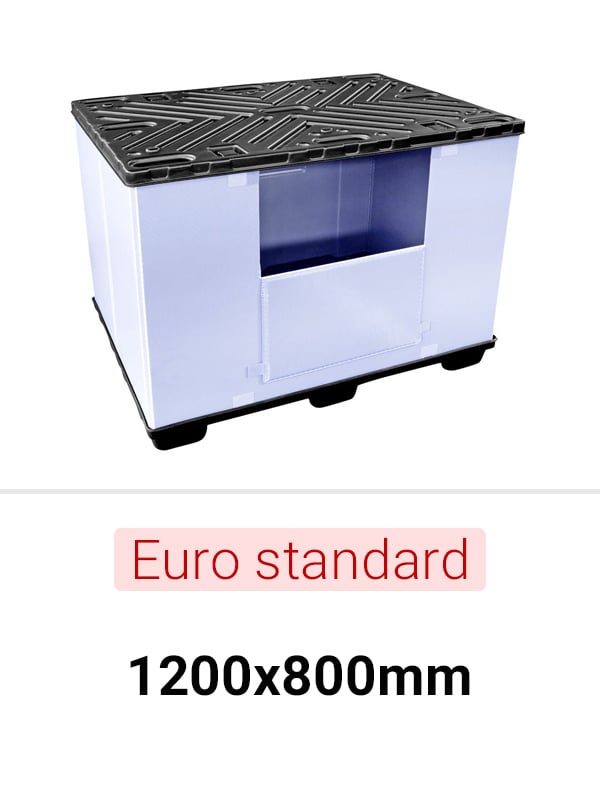
P1208 | 1200 × 800 | 1135 × 735 | 6:1 | 500 kg | Euro-palletlussen, retail, algemene productie |
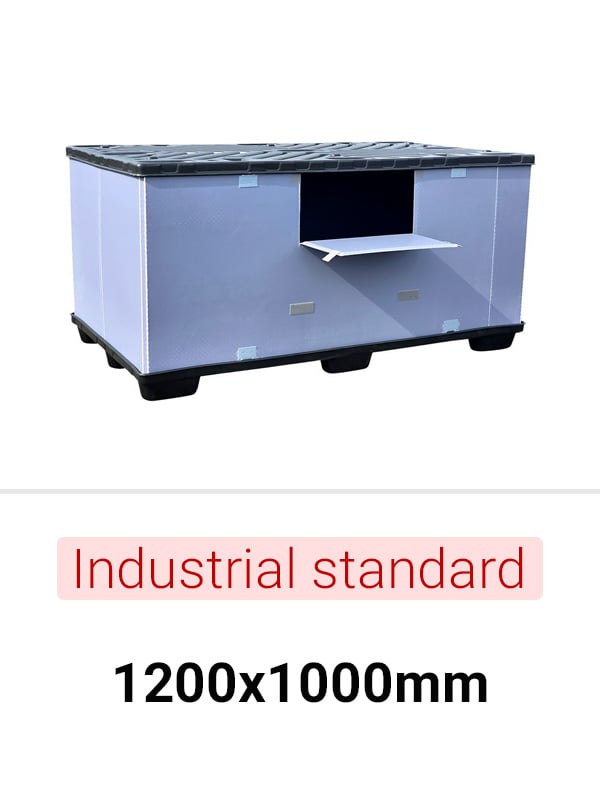
P1210 | 1200 × 1000 | 1140 × 940 | 6:1 | 500 kg | Automotive, zware componenten, industriële distributie |
Table 8 – Standard sizes
External (mm) | Internal (mm) | Qty: 0.5 truck | Qty: full Mega trailer |
800 × 600 | 730 × 530 | 350 | 890 |
1200 × 800 | 1135 × 735 | 160 | 400 |
1250 × 850 | 1200 × 800 | 140 | 375 |
1200 × 1000 | 1140 × 940 | 129 | 360 |
1230 × 1030 | 1175 × 970 | 120 | ~340 |
1200 × 800 (3-runners) | 1130 × 730 | 120 | 300 |
1200 × 1000 (3-runners) | 1130 × 930 | 100 | 260 |
Opmerking: truckaantallen zijn gebaseerd op standaard stapelaannames voor ingeklapte units. Werkelijke aantallen kunnen variëren door sleevehoogte, pallet-/basisontwerp, stapelstabiliteit, dunnage dat tijdens retourtransport in de unit blijft, en klantspecifieke transportbeperkingen.
Tabel 9 - Container- en lange maten
External (mm) | Internal (mm) | Qty: 0.5 truck | Qty: full Mega trailer |
1150 × 1150 | 1100 × 1100 | 140 | 320 |
1220 × 1150 | 1145 × 1100 | 114 | 290 |
1350 × 1150 | 1290 × 1090 | 114 | 260 |
1470 × 1150 | 1400 × 1080 | 114 | 260 |
1500 × 800 | 1440 × 740 | 140 | 375 |
1600 × 1150 | 1540 × 1080 | 86 | 225 |
1830 × 1130 | 1780 × 1065 | 86 | 196 |
2070 × 1150 | 2000 × 1080 | 71 | 163 |
Tabel 10 - Speciale maten
External (mm) | Internal (mm) | Qty: 0.5 truck | Qty: full Mega trailer |
820 × 620 | 770 × 570 | 350 | 840 |
1100 × 1100 | 1050 × 1050 | 140 | 320 |
1100 × 1000 | 1035 × 935 | 140 | 390 |
1150 × 985 | 1100 × 930 | 140 | 390 |
1200 × 1060 | 1140 × 1000 | 129 | 340 |
1240 × 1200 | 1190 × 1150 | 114 | 310 |
1590 × 980 | 1530 × 920 | 86 | 225 |
Naast footprint en hoogte zijn ZAMKO sleeve pack systemen configureerbaar binnen acht standaard optiecategorieën. De meeste projecten kunnen worden gespecificeerd vanuit het standaardassortiment zonder volledig maatwerkontwerp.
Tabel 11 - Beschikbare opties en wanneer u ze specificeert
Optie | Kies wanneer... | Belangrijkste voordeel | Afweging / opmerking |
Vergrendelingssysteem op deksel en pallet | Trillingsrisico, lange afstanden, stapeling boven 3 lagen, automotive supply chains | Voorkomt onbedoeld openen en ladingverschuiving | Zorg voor compatibiliteit met handling-SOP |
Sleeve met hogere dichtheid | Zware onderdelen, frequente cycli, hoger impact- of schokrisico | Hogere duurzaamheid en lager schadepercentage | Hogere materiaalkosten per unit |
Logo- en barcodebedrukking | Hoge eisen aan scanning/traceerbaarheid, branded circuits | Minder scanfouten; geen aparte labelapplicatie | Na bedrukking vast - plan vóór bestelling |
Labelhouder(s) | Product- of bestemmingsdata wisselen tussen cycli | Herpositioneerbaar; vermindert scanfouten en herstelwerk | Standaardiseer labelpositie in de hele vloot |
Handgrepen op het deksel | Handmatige processen, ergonomische handling vereist | Sneller deksel verwijderen; minder handlingbelasting | Kleine gewichtstoename |
Aangepaste sleevekleur | Multi-klantpooling, meerdere productfamilies of fabrieken | Visueel beheer; minder foutsortering | Minimum bestelhoeveelheid kan gelden |
ESD- en vlamvertragend materiaal | Elektronica, statisch gevoelige goederen, chemische distributie | Vermindert ESD-risico; voldoet aan compliance-eisen | Controleer tegen klant- of industrienorm - zie sectie 11 |
Track-and-trace module (RFID) | Poolingcircuits, hoge assetwaarde, verliesrisico | Inzicht op assetniveau; betere benutting - zie sectie 19 | Requires process discipline and reader infrastructure |
Sleeve pack systemen zijn beschikbaar als standaardproducten, maar de grens tussen standaard en maatwerk is kleiner dan veel kopers verwachten. De meeste praktijktoepassingen kunnen worden ingevuld met standaardfootprints, sleevehoogtes en materiaalgrades - aangevuld met configuratieopties uit een vast keuzemenu. Echt maatwerk is gereserveerd voor afwijkende footprints, ongebruikelijke ladinggeometrieën of toepassingen waar standaardopties niet voldoen.
Het kernprincipe: standaardiseer alles wat de logistiek raakt (footprint, ingeklapte hoogte, stapelconfiguratie) en pas alles aan wat het product raakt (sleevedichtheid, toegang, materiaalgrade, identificatie). Standaardisatie van de footprint houdt uw verpakking compatibel met stellingen, vrachtwagens en automatisering. Maatwerk aan productcontactelementen beschermt uw goederen en voldoet aan compliance-eisen zonder logistieke efficiëntie op te offeren.
De meest operationeel relevante maatwerkoptie is het uitneembare frontpaneel - ook laaddeur of drop-front genoemd. Standaard sleeve pack systemen worden van boven geladen, wat bovenloopkraantoegang of een ergonomisch zware hefbeweging vraagt. Een uitneembaar frontpaneel aan de lange of korte zijde maakt horizontale toegang op vloerniveau of transportbandhoogte mogelijk en verlaagt laadtijd en fysieke belasting in handmatige processen aanzienlijk.
Uitneembaar paneel aan de lange zijde (meest gebruikt): biedt de breedste toegang - de volledige interne lengte van de sleeve (bijvoorbeeld 1.135 mm bij footprint 1200×800). Geschikt voor brede, vlakke componenten zoals plaatwerkdelen, kunststof panelen en grote gietstukken, en voor ergonomisch laden aan een vaste productiewerkplek. Afhankelijk van het ontwerp schuift het paneel verticaal uit of klapt het omlaag. De volledige breedteopening maakt nauwkeurig plaatsen van grote componenten mogelijk zonder kantelen.
Both configurations are designed to collapse and transport in the same way as standard sleeve packs – the panel folds or stacks with the sleeve when collapsed, maintaining the fold ratio.
Tabel 12a - Configuraties met uitneembaar paneel: lange zijde versus korte zijde
Kenmerk | Paneel lange zijde | Paneel korte zijde |
Breedte toegangsopening | Volledige sleevelengte (bijv. 1.135 mm intern bij 1200×800) | Volledige sleevebreedte (bijv. 735 mm intern bij 1200×800) |
Beste voor | Brede of vlakke componenten; ergonomisch handmatig laden aan werkstation; hoge pickfrequentie | Belading via transportband vanaf de korte zijde; compacte productiecellen; smalle gangpaden |
Effect op vouwratio | Geen - paneel klapt mee met de sleeve | Geen - paneel klapt mee met de sleeve |
Effect op stapelstijfheid | Lichte reductie aan openingszijde; gecompenseerd door hoekconstructie | Lichte reductie aan korte zijde; meestal acceptabel bij standaardladingen |
Effect op unitprijs | +5-12% versus standaard sleeve (extra scharnier en randversterking) | +5-12% versus standaard sleeve |
Typische sectoren | Automotive-Teile, Elektronikmontage, manuelle Distribution | Productielijnintegratie, cold-chainbelading, compacte productiecel |
For applications involving static-sensitive goods – printed circuit boards, sensor modules, battery management electronics, display panels or semiconductor components – standard polypropylene may not provide the ESD protection required by the application. Standard PP is electrically insulating and can accumulate electrostatic charge. ESD-grade sleeve packs use carbon-loaded or antistatic PP formulations in the sleeve wall material.
Voor elektronicatoepassingen die ESD-verpakking vereisen, zie maatwerk palletboxen voor elektronicaproductie.
The key parameter is surface resistivity. Electrostatic dissipative (ESD) grades may be specified in the 10⁴ to 10¹¹ ohm range, depending on the packaging requirement and ESD control programme. Conductive grades are below 10⁴ ohms. The required property limits and test evidence should be confirmed for the specific application.
The relevant standard is IEC 61340-5-3 (‘Protection of electronic devices from electrostatic phenomena – Properties and requirements classification for packaging intended for electrostatic discharge sensitive devices’). Note that the ESD grade applies to the sleeve wall material – standard HDPE pallets and lids are not ESD-grade unless separately specified.
Flame-retardant (FR) sleeve packs may be required when fire safety regulations impose restrictions on combustible materials in storage areas, when customer or end-user packaging standards specify FR materials, or when insurance requirements for specific storage categories mandate non-standard combustibility ratings.
FR-grade PP sleeve material can be formulated to achieve a UL 94 V-0 rating – a defined vertical-burning classification with specified afterflame and dripping criteria. The required rating and test documentation should be validated for the project.
For high-cycle applications with FR-grade sleeves, validate against your specific cycle frequency and handling intensity.
Tabel 12b - Vergelijking materiaalgrades: standaard PP versus ESD versus vlamvertragend
Eigenschap | Standaard PP | ESD-dissipatieve grade | Vlamvertragende grade (UL 94 V-0) |
Oppervlakteweerstand | >10¹² ohm (isolerend) | 10⁴ tot 10¹¹ ohm | Standard (not ESD-rated) |
Brandbaarheidsclassificatie | UL 94 HB | UL 94 HB (tenzij gecombineerd) | UL 94 V-0 |
Relevante norm | – | IEC 61340-5-3 | UL 94 / EN 45545 (railtoepassingen) |
Typische toepassingen | Algemeen industrieel, automotive, distributie | Elektronica, EV-batterijlogistiek, halfgeleiders | Chemische magazijnen, batterijopslag, FR-gespecificeerde omgevingen |
Slagvastheid versus standaard | Referentie | Vergelijkbaar | Licht verlaagd - valideer bij hoogcyclisch gebruik |
Kosten versus standaard sleeve | Referentie | Project-dependent – varies by formulation, resistance requirement, documentation and quantity | Project-dependent – varies by formulation, required rating, documentation and quantity |
Recyclebaarheid: | Hoog - monomeer PP | Hoog - gespecialiseerde recycler aanbevolen | Lager - FR-additieven bemoeilijken recycling |
The cost of customisation is not only the unit price premium – it is also supply chain complexity of maintaining non-standard stock, longer lead times for replenishment, and the reduced option for using used/inspected stock, which is typically concentrated in standard specifications. Standardise when: the application is general industrial, the load is within standard weight and size parameters, pooling or multi-customer use is planned, and cost minimisation is the primary driver.
Customise when: load characteristics demand it (ESD sensitivity, FR requirement, unusual geometry), production line access drives ergonomic requirements (removable panel), or visual management of a complex multi-loop circuit requires colour or print identification. Never customise the footprint unless no standard size fits your logistics infrastructure – non-standard footprints lose compatibility with racking, standard trucks, and automation, and make used stock replacement impossible.
Tabel 12c - Overzicht maatwerkopties
Optie | Wanneer specificeren | Operationeel voordeel | Afweging |
Uitneembaar frontpaneel - lange zijde | Brede of vlakke componenten; ergonomisch laden aan productiestation | Horizontale toegang op vloerniveau; verlaagt laadtijd en operatorbelasting | +5-12% kosten; lichte reductie van wandstijfheid aan openingszijde |
Uitneembaar frontpaneel - korte zijde | Belading vanaf korte zijde via transportband; compacte productiecellen | Toegang via korte maat; ruimte-efficiënte positionering | +5-12% kosten |
ESD-dissipatieve sleeve (10⁴-10¹¹ ohm) | Printplaten, sensoren, batterijmanagementelektronica, displaypanelen | Supports controlled charge dissipation; confirm packaging performance and test documentation against IEC 61340-5-3 | Project-dependent premium; ESD applies to the sleeve wall only – confirm surface-resistance requirement, test documentation and pallet/lid grade |
Vlamvertragende sleeve (UL 94 V-0) | Chemische magazijnen, batterijopslag, FR-gespecificeerde omgevingen | UL 94 V-0 material grade available; validate the specified material and test evidence against the project’s fire-safety requirements | Project-dependent premium; validate material formulation and impact resistance for high-cycle use |
Aangepaste sleevehoogte | Producthoogte valt tussen standaardopties; specifieke stapelbehoefte | Elimineert loze bovenruimte; optimaliseert stapellagen per truck | Minimum order quantity may apply for non-standard heights |
Kleurgecodeerde sleeves | Multi-product- of multi-klantcircuits; visueel kwaliteitsbeheer | Directe visuele identificatie; minder foutsortering | Minimum bestelhoeveelheid; beperkte meerprijs |
Sleevewand met hogere dichtheid | Zware onderdelen boven 300 kg dynamisch; ruwe handling; frequente cycli | Hogere slagvastheid; minder wandscheuren | Hogere materiaalkosten; iets zwaarder; licht lagere vouwratio |
Maatwerk dunnage-integratie | Precisiecomponenten die scheiding tussen onderdelen vereisen | Voorkomt contactschade; dunnage blijft binnenin bij inklappen | Voegt kosten en gewicht toe; moet voor specifieke onderdeelgeometrie worden ontworpen |
De juiste sleeve pack configuratie kiezen is een technische beslissing, geen cataloguskeuze. Werk vier vragen in volgorde af.
If yes, specify a 3-runner base configuration. If no, a standard flat-base configuration is often better value.
If loads regularly approach or exceed 400 kg, specify a model with a 500 kg dynamic rating and validate against your actual forklift handling conditions. If loads are consistently below 300 kg, a standard dynamic rating is usually sufficient and more cost-effective.
Bij lussen boven 400 km worden ingeklapte hoogte en vouwratio financieel belangrijk - zie sectie 5. Bij korte circuits onder 200 km heeft een iets hogere ingeklapte hoogte minder financiële impact.
In many of standard industrial applications, inspected and repaired used sleeve packs can deliver comparable operational performance to new stock. New stock is preferable for food-grade, pharmaceutical, ESD-certified, or automation-tolerance-critical applications.
Tabel 13 - Beslismatrix voor configuratie
Beslissingsgebied | Optie | Kies wanneer... | Afweging |
Basisconfiguratie | Standaard vlakke basis | Handmatige en heftruckhandling, kostenbeheersing prioriteit | Minder compatibel met sommige geautomatiseerde flows |
Basisconfiguratie | 3-runner basis | Automatisering, transportbanden, reproduceerbare geometrie vereist | Iets hoger tarragewicht en kosten |
Sleevedichtheid | Standaarddichtheid | Algemeen industrieel gebruik, gemiddeld risicoprofiel | Lagere slagvastheid dan versterkte sleeves |
Sleevedichtheid | Hoge dichtheid | Zware onderdelen, frequente cycli, hoger impact- of schokrisico | Hogere materiaalkosten |
Deksel / pallet | Zonder vergrendeling | Korte afstand, gecontroleerde handlingomgeving | Niet geschikt voor trillingsintensief |
Deksel / pallet | Met vergrendeling | Lange afstand, stapeling boven 3 lagen, automotive | Minor additional cost; ensure SOP compatibility |
Materiaal: | Standaard PP | Algemeen industrieel, chemisch compatibele ladingen | Niet geschikt voor ESD-gevoelige goederen |
Materiaal: | ESD of vlamvertragend | Elektronica, chemicaliën, compliance-gedreven toepassingen | Hogere kosten; controleer normconformiteit - zie sectie 11 |
Werk de vier vragen hierboven af en pas deze regels toe om tot uw specificatie te komen:
Niet zeker welke configuratie bij uw toepassing past? De inkoopgids voor herbruikbare verpakking behandelt het volledige specificatieproces, inclusief vlootomvang, footprintkeuze en total-cost-of-ownershipmodellering.
Klaar om te specificeren? Stuur ZAMKO uw ladingprofiel en retourparameters en ontvang een configuratieadvies met kosten-per-cyclusberekening.
Kies sleeve pack systemen wanneer vouwratio en hoogteflexibiliteit de kosten per cyclus bepalen, wanneer modulaire componentvervanging belangrijk is, en wanneer uw supply chain gesloten retourlussen met regelmatig retourtransport heeft.
Kies een multiplex krat wanneer er geen betrouwbare retourlus is - eenmalige overzeese export, projectlading of machinezendingen waarbij de ontvanger niet deelneemt aan retourtransport. Multiplex kratten zijn ook de juiste keuze voor kwetsbare of onregelmatig gevormde goederen die maatwerk interne ondersteuning nodig hebben. ZAMKO levert beide formaten.
The realistic maximum fold ratio for a standard 1200 mm assembled-height sleeve pack is 6:1, giving a collapsed height of approximately 200 mm. At 6:1, a full Mega trailer carries approximately 360 collapsed 1200×1000 sleeve packs on the return leg versus 52 assembled – an approximately 7:1 improvement in truck utilisation. In practice, stacking stability and carrier restrictions make 6:1 the realistic ceiling. Higher fold ratios require higher stacks which reduce stacking stability during transport: fold ratio is an engineering trade-off, not purely a marketing number.
ZAMKO offers ESD-grade PP sleeve material. Depending on the packaging requirement and ESD control programme, surface resistivity may be specified in the 10⁴ to 10¹¹ ohm range. Packaging performance and test documentation should be confirmed against IEC 61340-5-3 for the specific application. The ESD option applies to the sleeve wall material – the pallet and lid are standard HDPE unless otherwise specified. Confirm your specific resistivity requirement with ZAMKO at the time of order. See Section 11 for the full ESD and material grade guide
Ja, als retourlogistiek haalbaar is. Als retouren niet mogelijk zijn, zijn multiplex kratten de betere keuze. Als retouren wel mogelijk maar niet frequent zijn, maakt gebruikte sleeve pack voorraad met lagere kapitaalkosten de businesscase vaak alsnog haalbaar.
Ja. Het ontwikkelingsteam van ZAMKO maakt maatwerk sleeve pack systemen op basis van projectvereisten. Opties zijn onder meer uitneembare frontpanelen (lange of korte zijde), ESD- en vlamvertragende materiaalgrades, afwijkende footprints, aangepaste sleevehoogtes, sleeves met hogere dichtheid, speciale materiaalgrades (sleeves tot 18 mm) en merk- of kleurcodering. Zie sectie 11 voor de volledige maatwerkgids.
De keuze van een sleeve pack footprint gaat niet alleen over wat om het product past. De footprint bepaalt compatibiliteit met stellingen, truckbelading, automatische handling en poolingcircuits. Een sleeve pack systeem met afwijkende footprint kan het product perfect beschermen, maar tegelijk niet passen in de stellingen van de ontvanger, het laadpatroon van de vervoerder of een toekomstige poolingafspraak.
ISO 6780:2003 ("Flat pallets for intercontinental materials handling - Principal dimensions and tolerances") is de primaire wereldwijde norm voor internationaal erkende palletfootprints. Voor Europese industriële logistiek domineren twee footprints: 1200×800 mm (ISO 6780 ISO1 / EUR-palletfootprint) en 1200×1000 mm (ISO 6780 ISO2 / industriële palletfootprint).
De footprint 1200×800 mm (ISO1) is het meest gebruikte formaat in West-Europese logistiek. Het past in standaard Europese palletstellingen, laat 33-34 units per standaard trailerbodem toe (twee rijen van 17) en sluit aan op de EPAL EUR-palletstandaard voor houten palletpooling in Europa. Sleeve pack systemen op deze footprint zijn direct compatibel met elke stelling- of handlingomgeving die voor EUR-pallets is ontworpen. De 1200×1000 mm footprint (ISO2) is de standaard voor zwaardere industriële ladingen in Europese productie - met 25% meer oppervlak, geschikt voor grotere componenten en hogere laadvolumes per unit.
Tabel 14a - Standaardfootprints en logistieke compatibiliteit
Voetafdruk | ISO-aanduiding | Past per standaard trailerbodem | Past per Mega trailer (ingeklapt) | Stellingcompatibiliteit | Primaire gebruikscontext |
1200 × 800 mm | ISO1 / EUR pallet | 33 (-34) units | 400 collapsed units | Universal European racking – standard beam pitch | West-Europese distributie, automotive Tier supply, FMCG |
1200 × 1000 mm | ISO2 / industrial | 26 (-27) units | approx. 360 collapsed units | Industriële stellingen - controleer balkafstand voor 1000 mm diepte | Zware productie, automotive OEM, industriële bulkdistributie |
1250 × 850 mm | Non-standard | 30–32 units | 375 ingeklapte units | Verify – not universally compatible with EUR racking | Specific applications requiring slightly larger base than EUR |
1230 × 1030 mm | Non-standard | 24–26 units | ~340 collapsed units | Verify – close to ISO2 but not ISO-standard | Applications requiring slightly extended ISO2 footprint – note: larger footprint than ISO2 means fewer units per truck than 1200×1000 |
800 × 600 mm | Half EUR | 60+ units | 890 collapsed units | Half-pallet racking positions | Small components, secondary distribution, half-pallet logistics |
De EPAL EUR-pallet (1200×800 mm) is het meest gebruikte poolpalletformaat in Europa. De EPAL-pool betekent dat EUR-pallets één-op-één tussen pooldeelnemers kunnen worden geruild. Sleeve pack systemen op de 1200×800 footprint zijn maatvoeringstechnisch compatibel met EUR-palletinfrastructuur - dezelfde stellingen, dezelfde trucks, dezelfde vorkvrijheden - maar ze maken geen deel uit van de EPAL-ruilpool. Een sleeve pack systeem is eigendom van een specifiek bedrijf en moet naar dat bedrijf terugkeren. Dit is belangrijk voor inkoopteams die gewend zijn aan palletruilsystemen: sleeve pack logistiek vraagt een beheerde retourlus, geen ruilgebaseerde pool. De retourdiscipline moet expliciet tussen verzender en ontvanger worden afgesproken.
Onderling stapelen - sleeve pack systemen van verschillende fabrikanten of modellen op elkaar stapelen - is in sommige gevallen technisch mogelijk, maar meestal onbetrouwbaar en niet aanbevolen als standaardpraktijk. Redenen zijn verschillen in dekselgeometrie, maatvoeringstoleranties en stapelbelastingcertificering. Verschillende ontwerpen hebben andere oppervlakken en stapelvoeten, waardoor belasting verkeerd kan worden verdeeld. Zelfs binnen dezelfde nominale footprint kunnen externe afmetingen per fabrikant afwijken binnen toleranties. Bovendien gelden load ratings voor specifieke unit-op-unitcombinaties; mixen van merken maakt de stapelcertificering voor de combinatie ongeldig. In een single-operator, single-circuit vloot is onderling stapelen meestal acceptabel als beide units samen zijn getest en stabiel zijn bevonden. In multi-operator poolingcircuits moet onderling stapelen tussen merken worden vermeden.
Standaard Europese palletstellingen zijn ontworpen rond de footprints 1200×800 en 1200×1000, met balkafstanden en legbordindeling daarop afgestemd. Sleeve pack systemen op deze footprints kunnen direct in stellingen worden geplaatst - zonder extra aanpassing. Voor AS/RS-systemen (automated storage and retrieval systems) en transportbanden zijn de kritische parameters: externe footprinttolerantie (AS/RS vraagt meestal ±3-5 mm; spuitgegoten en 3-runner basisconfiguraties bieden constantere geometrie dan standaard vlakke blow-moulded pallets), basisgeometrie (runnerafstand en hoogte moeten passen bij transportband of AS/RS) en opgebouwde hoogte (moet worden getoetst aan de maximale hoogte van uw transportbaan).
Voor bedrijven die multi-partner pooling overwegen - waarbij sleeve pack systemen circuleren tussen meerdere leveranciers, een logistiek dienstverlener en meerdere ontvangers - is footprintstandaardisatie bij alle pooldeelnemers niet onderhandelbaar. Een pool met zowel 1200×800 als 1200×1000 units is niet efficiënt te beheren, omdat ingeklapte stapeling en truckbelading per footprint verschillen. Praktisch advies: kies één footprint voor de volledige pool en ontwerp het poolcircuit daaromheen. De 1200×1000 footprint heeft meestal de voorkeur voor nieuwe poolingprogramma’s, omdat de grotere basis meer soorten lading aankan. De 1200×800 footprint heeft de voorkeur wanneer compatibiliteit met EUR-palletinfrastructuur de primaire beperking is.
Table 14b – Inter-stacking and compatibility summary
Scenario | Onderling stapelen veilig? | Belangrijkste risico | Aanbeveling |
Zelfde model, zelfde fabrikant, één vloot | Ja - binnen gecertificeerde belasting | Geen indien binnen gecertificeerde configuratie | Standaardpraktijk - valideer stapelbelasting |
Verschillende modellen, zelfde footprint, zelfde fabrikant | Meestal ja - testen en bevestigen | Kleine verschillen in dekselgeometrie kunnen belastingverdeling beïnvloeden | Test vóór vlootuitrol |
Verschillende fabrikanten, zelfde nominale footprint | Niet aanbevolen - eerst valideren | Maattoleranties kunnen instabiliteit veroorzaken; stapelcertificering vervalt | Alleen doorgaan na fysieke test onder belasting |
Gemengde footprints (bijv. 1200×800 met 1200×1000) | Nee | Footprintmismatch veroorzaakt instabiele stapel | Standaardiseer footprint in de hele vloot |
Multi-partner pooling - gemengde merken | Vermijden | Certificering vervalt; verliespercentage stijgt door niet-standaard handling | Definieer één footprint en één goedgekeurde specificatie voor de pool |
For many buyers, damage cost is a hidden line item that can outweigh the purchase-price difference between packaging options. In automotive and high-value industrial supply chains, packaging-related damage can lead to claims, rework, production disruption or line impact. The financial exposure is highly application-specific. Packaging failure is therefore not only a packaging cost – it is an operational risk.
Tabel 15 - Transportschade: oorzaken en beperking met sleeve pack ontwerp
Oorzaak | Wat gebeurt er | Beperking via sleeve pack ontwerp |
Onvoldoende dunnage | Onderdelen verschuiven en botsen door transporttrillingen | Specificeer vakverdeling, trays of foam-inserts; leg pakpatroon vast vóór eerste cyclus |
Te hoog stapelen | Wanddoorbuiging en dekselvervorming | Definieer stapellimieten; valideer statische en dynamische belasting tegen uw configuratie |
Heftruckimpact | Palletschade en scheuren in wand | Specificeer runners/skids en versterkte hoeken; train handling-SOP; overweeg sleeve met hogere dichtheid |
Vochtblootstelling | Corrosie van onderdelen of falende labels | Gesloten wanden en deksel; definieer opslagcondities; voeg labelbeschermingszones toe |
Gemengde lussen of zwakke retourdiscipline | Verloren verpakking, wisselende beschikbaarheid, contaminatie | Implementeer RFID-tracking, poolingdiscipline en standaardfootprints bij alle deelnemers |
Sleeve pack systemen kunnen automatiseringsvriendelijk zijn, maar alleen wanneer geometrie, runnerconfiguratie en maattoleranties passen bij uw transportbanden, AS/RS of robotische handling. Belangrijkste compatibiliteitschecklist:
For automated lines: a single handling error causing a line stoppage typically costs more than the entire price difference between a standard and automation-grade sleeve pack fleet. Specify correctly from the start. See Section 13 for footprint tolerance and runner configuration guidance.
De vereisten voor sleeve pack systemen zijn niet in elke sector hetzelfde. De juiste configuratie voor een automotive Tier 1-leverancier verschilt sterk van de juiste specificatie voor een elektronicaproducent of chemische distributeur.
Automotive supply chains are one of the largest and most established application areas for sleeve pack systems in Europe. The structural reasons: automotive supply chains operate on highly predictable, hoogfrequente gesloten lussen,componentgewichten liggen vaak tussen 200 en 500 kg, en de kosten van verpakkingsfalen zijn hoog.
Een hoogvolume fabrikant met een dagelijkse volle-vrachtwagenlus naar een productielocatie 400 km verderop verzendt 52 palletladingen per dag, vijf dagen per week - 13.520 uitgaande zendingen per jaar. Voorheen gebruikte het bedrijf eenmalige golfkartonnen palletboxen à €14 per stuk plus een lichte eenmalige houten pallet eronder à €5 (na één gebruik doorverkocht voor €1). De jaarlijkse systeemkost voor verpakking bedroeg inclusief afvoer circa €270.400 per jaar. De overstap naar een vloot van 1.456 sleeve pack systemen (1200×1000, standaarddichtheid, vergrendelbaar deksel) à €100 per unit - een eenmalige vlootinvestering van €145.600 - verlaagt de jaarlijkse operationele kosten in dit illustratieve begin 2026 transportmodel naar circa €91.000 (alleen retourtransport van ingeklapte lege units). Jaarlijkse besparing: circa €179.400. Terugverdientijd: ongeveer 10 maanden. De cijfers zijn indicatief en afhankelijk van route, contracttarief, verblijftijd en schadeverschil.
Deze cijfers zijn gebaseerd op een realistisch operationeel profiel. Vraag een maatwerk sleeve pack ROI-berekening aan om uw eigen lus te modelleren.
Automotive-specific configuration requirements: dunnage compatibility (stamped parts and precision components require foam inserts or PP divider systems fitted inside the sleeve), ESD protection for EV battery electronics and control units, locking lid and pallet for long-distance multi-stop transport runs, and barcode or RFID traceability for OEM packaging standards compliance.
Customer references should be handled at sector level unless there is documented permission en substantiation for a named case reference.
For automotive supply chain packaging, the combination of high fold ratio, closed walls, and OEM-compatible base specification makes sleeve packs a common choice across JIT and milk-run circuits where closed-wall protection and return efficiency matter.
Electronics applications centre on static control, dimensional precision, and cleanliness. For ESD-sensitive goods – PCBs, display panels, sensors, battery management electronics – ESD-grade PP sleeve material is mandatory.
For automotive electronics applications – EV battery management, ADAS sensors, control units and general electronics manufacturing – the ESD and cleanliness requirements from both sectors apply simultaneously, requiring both IEC 61340-5-3 compliance and automotive-grade RFID traceability.
ZAMKO’s ESD option uses carbon-loaded or antistatic PP formulations with surface resistivity in the range of 10 to 10 ohms, meeting IEC 61340-5-3 requirements for ESD protective packaging of electronic devices. The sealed edge construction prevents fibre or particle shedding. The 3-runner base configuration is a common specification for automated electronics lines where conveyor interface tolerances are tight. Customer references should be handled at sector level unless there is documented permission and substantiation for a named case reference.
Chemische distributie en productie vragen om betrouwbare containment, hygiënedocumentatie en regulatory compliance. Standaard PP is bestand tegen veel industriële chemicaliën, maar compatibiliteit moet worden gevalideerd tegen specifieke chemische families en concentraties. Vlamvertragende materiaalgrade is beschikbaar voor toepassingen waar standaard PP niet aan veiligheidseisen voldoet. De vervangbaarheid op componentniveau van sleeve pack systemen vereenvoudigt reinigingsvalidatie en lifecycle-documentatie voor ISO 14001- en GMP-omgevingen.
Beyond the industry-specific applications above, sleeve packs are a widely used returnable packaging format across general manufacturing and industrial distribution wherever three conditions are simultaneously present: a predictable return loop, loads in the 100–500 kg range, and a cost reduction target on packaging spend.
ZAMKO pallet boxes are used across industrial production, warehousing, transport, and distribution environments, including automotive, electronics, building materials, chemicals, healthcare-related logistics, consumer goods and general manufacturing.
Sleeve pack systemen worden ook gebruikt in distributie van landbouwproducten, bouwmaterialenlogistiek, recyclingcircuits, retaildistributie en doe-het-zelf, en event- en beurslogistiek. De gemene deler is een gesloten of semi-gesloten logistieke lus waarin het kosten-per-cyclusmodel beter presteert dan eenmalige alternatieven.
Seizoenslogistiek - groente- en fruitdistributie en agrarische inputs - profiteert vooral van de omgevingstemperatuurtolerantie en bestendigheid tegen kortdurende buitenopslag van sleeve pack systemen.
Sleeve pack systemen zijn de juiste oplossing voor veel gesloten industriële toepassingen - maar niet voor elke toepassing.
Tabel 16 - Alternatieven voor sleeve pack systemen: wanneer elk formaat wint
Format | Kies boven sleeve pack systemen wanneer... | Belangrijk voordeel t.o.v. sleeve pack | Belangrijk nadeel t.o.v. sleeve pack |
Multiplex kratten | Eenmalige overzeese export of projectlading zonder retourlus; kwetsbare of onregelmatig gevormde goederen die maatwerk interne ondersteuning vereisen; sommige specialistische herbruikbare toepassingen over lange levensduur | Volledig maatwerk interne ondersteuning voor elke ladinggeometrie; lagere kosten bij echt eenmalig gebruik; geaccepteerd door alle expediteurs | Niet ontworpen voor hoogfrequente retourlussen; zwaarder en volumineuzer; hogere kosten per cyclus bij herbruikbare toepassingen |
Gaascontainers | Zicht op lading en ventilatie vereist; zware industriële onderdelen waarbij 360° inspectietoegang belangrijk is; e-waste inzameling; toepassingen waar open-mesh airflow operationeel nodig is | Sterke retourtransportefficiëntie - typisch 3-4x meer lege units per truck, sommige modellen tot 6:1; volledige visuele inspectie zonder lossen; robuuste staalconstructie | Geen stof- of vochtbescherming; hoger tarragewicht; corrosierisico in natte omgevingen |
Stapelrekken | Ladingen zijn zelfdragend, vlak of profielvormig en vereisen geen gesloten wanden; laag tarragewicht is kritisch | Zeer laag tarragewicht; volledige toegankelijkheid van alle zijden; ontworpen voor zelfdragende ladingen zonder wanden | Geen contaminatiebescherming; lading moet zelfdragend zijn of apart worden gezekerd |
Rolcontainers | Last-mile distributie met mobiliteit op vloerniveau in retail- of magazijnomgevingen; handmatig duwen tussen pickstations | Op wielen - mobiel zonder heftruck; ideaal voor handpicking en retaillevering | Niet geschikt voor heftruckintensieve of gestapelde wegtransportomgevingen |
Vouwbare IBC’s | Vloeibare of halfvloeibare bulkproducten die een gesloten container vereisen | Specifiek ontworpen voor vloeistofcontainment; UN-gecertificeerde varianten voor gevaarlijke stoffen | Niet uitwisselbaar met sleeve pack systemen; andere footprint en handlingvereisten |
Tabel 17 - Selectie per logistiek model
Logistiek model / primaire eis | Best passend formaat | Waarom |
Gesloten retourcircuit, stof- of vochtbescherming vereist, focus op transportkosten | Sleeve Pack Systemen | Hoogste combinatie van vouw-efficiëntie en gesloten-wandbescherming; modulaire repareerbaarheid; optimale kosten per cyclus in hoogfrequente lussen |
Gesloten retourcircuit, voorkeur voor geïntegreerde wandstijfheid, standaardhandling | Vouwbare kunststof palletboxen | Sterke vouwratio; eenvoudigere opbouw; geïntegreerde stijve wanden zonder losse sleevecomponent |
Zware industriële onderdelen, visuele inspectie vereist, ventilatie nodig | Gaascontainers | 3-4x retourefficiëntie bij veel modellen; volledige 360° zichtbaarheid; staalconstructie verwerkt hoge puntbelastingen |
Eenmalige export, geen retourlus, maatwerk interne bescherming vereist | Multiplex kratten | Günstigste Lösung bei echter Einwegnutzung; individuelle Innenabstützung; speditionstauglich |
Vlakke of profielvormige ladingen (plaatwerk, glaspanelen), geen gesloten omhulling nodig | Stapelrekken | Laagste tarragewicht; volledige toegankelijkheid; ontworpen voor zelfdragende ladingen zonder wanden |
Interne magazijnmobiliteit, handmatig duwen, retail last-mile | Rolcontainers | Op wielen voor handmatige beweging; ideaal voor pickprocessen en retaillevering zonder heftruckhandling |
Tabel 18 - Retourefficiëntiefactoren per verpakkingsformaat
Retourefficiëntiefactor | Sleeve Pack Systemen | Vouwbare kunststof palletboxen | Gaascontainers |
Vouwratio (typische bandbreedte) | Zeer hoog - klapt in tot ~15% van het volume; veel configuraties halen 5:1 tot 6:1+ | Hoog - meestal sterk, maar modelafhankelijk; doorgaans minder compact dan sleeve pack systemen | Middel tot hoog - meestal 3:1 tot 4:1; sommige modellen halen 6:1 |
Snelheid inklappen / opbouwen | Middel - 3-componentensysteem vereist juiste opbouwvolgorde | Laag tot middel - afhankelijk van wandmechanisme; sommige modellen klappen in één beweging | Laag tot middel - meestal 2-3 vouwstappen; hoger gewicht vertraagt handling |
Stabiliteit lege stapel | Hoog - deksel en pallet vergrendelen de ingeklapte unit tot stabiele stapel | Hoog - ingeklapte units stapelen meestal stabiel | Middel - ingeklapte kooien kunnen zonder omsnoering verschuiven op lang transport |
Dunnage tijdens retour | Dunnage blijft binnenin bij inklappen - vouwratio blijft behouden met inserts op hun plaats | Afhankelijk van dunnagetype - sommige ontwerpen laten inserts zitten, andere vereisen verwijdering | Open gaas - dunnage moet meestal vóór retour worden verwijderd; extra handlingstap |
Bescherming tijdens retour | Hoog - gesloten wanden beschermen de ingeklapte unit zelf tegen contaminatie | High – closed walls on most models | Laag - open gaas; ingeklapte kooien blootgesteld aan omgeving tijdens retourtransport |
Organisatie retourstroom | Gestandaardiseerde footprint en ingeklapte hoogte vereenvoudigen retourplanning | Gestandaardiseerde footprint ondersteunt planning; ingeklapte hoogte verschilt per model | Gestandaardiseerde footprint; retourlogistiek goed ingeburgerd in zware industriële circuits |
Plywood crates are the correct format when there is no return loop, or for fragile/high-value goods requiring custom internal bracing. Some plywood crate designs are also reusable and repairable over multiple cycles. The practical decision rule: if packaging leaves and reliably returns, sleeve packs often win on cost per cycle. ZAMKO levert beide formaten..
Stapelrekken zijn het juiste alternatief wanneer de lading zelfdragend is en geen gesloten wanden nodig heeft - vaak 8-18 kg tegenover 20-35 kg voor een sleeve pack systeem, maar zonder contaminatiebescherming. Rolcontainers hebben een fundamenteel andere logistieke functie - geoptimaliseerd voor handmatige mobiliteit binnen een gebouw, niet voor heftruckhandling, wegtransport en gesloten retourcircuits. Vouwbare IBC’s zijn geschikt voor vloeibare of halfvloeibare toepassingen waar een gesloten container vereist is.
De drie scenario’s hieronder zijn representatief voor praktijktoepassingen - geen klantcases op naam, maar gebaseerd op operationele parameters die typerend zijn voor elk segment.
Een Tier 1 automotive leverancier verzendt 52 palletladingen per dag naar een productielocatie 400 km verderop, vijf dagen per week. Lege units worden na 4 weken verblijftijd bij de ontvanger in volledige ingeklapte ladingen retour gestuurd. Voorheen gebruikte de fabrikant eenmalige golfkartonnen palletboxen à €14 per unit.
Vlootvereiste: 52 units per dag × 28 dagen verblijftijd = 1.456 units tegelijk in het circuit. Plus 10% buffer voor inspectie en reparatie = 1.600 units aanbevolen. Dit voorbeeld gebruikt de basisvloot van 1.456 units à €100 per nieuwe unit. Eenmalige vlootinvestering: €145.600.
Rotatie: vanaf week 5 keren dagelijks 52 ingeklapte units terug. Jaarlijkse uitgaande zendingen: 52 × 5 × 52 = 13.520. Elk sleeve pack systeem maakt ongeveer 9 cycli per jaar (13.520 ÷ 1.456).
Belangrijke kost die vaak wordt gemist in kartonvergelijkingen: eenmalige golfkartonnen palletboxen hebben een houten pallet eronder nodig. Bij 13.520 zendingen per jaar betekent dit 13.520 lichte eenmalige houten pallets (1200×1000, dunne disposable kwaliteit - niet EPAL-gecertificeerd) à circa €5,00 per stuk - €67.600/jaar. Deze pallets kunnen meestal na één gebruik voor €1,00 per stuk worden doorverkocht aan een palletinzamelaar (bij 260 pallets/week komt elke Nederlandse pallethandelaar ophalen). Netto houten-palletkost: €54.080/jaar. Deze ene regel - vaak afwezig in verpakkingskostenvergelijkingen - versterkt de financiële case voor sleeve pack systemen aanzienlijk.
Tabel 19a - Scenario A: jaarlijkse kostenvergelijking - sleeve pack systemen versus volledig kartonsysteem
Kostenelement | Sleeve pack systemen (jaarlijks) | Kartonsysteem (jaarlijks) | Basis |
Aankoop kartonnen boxen | €0 | €189,280 | One-way: 13,520 boxes × €14. Sleeve packs: €0 running cost (fleet investment is one-time, shown below) |
Aankoop lichte eenmalige houten pallets | €0 | €67,600 | Karton vereist pallet eronder: 13.520 × €5,00 (dunne disposable kwaliteit, NL bulktarief 2025) |
Doorverkoopopbrengst houten pallets | €0 | −€13,520 | 13.520 gebruikte pallets × €1,00 doorverkoop aan palletinzamelaar (NL markt, 260/week volume) |
Retourtransport (ingeklapte lege units) | €91,000 | €0 | Sleeve pack: 1 truck/dag × 260 dagen × €350. Karton: geen retour nodig |
Afvoerkosten karton / verpakking | €0 | €27,040 | Karton: 13.520 boxen × €2,00 (arbeid + inzameling + EPR-producentenbijdrage) |
Schade en claims | €0 | €15,000–€50,000 | Cardboard: estimated 10–40 high-value incidents/year at €1,500–€5,000 each; lower-value incidents may be below this range – not included in totals below |
TOTALE jaarlijkse operationele kosten | €91,000 | €270,400 | |
Jaarlijkse besparing versus kartonsysteem | €179,400 | – | €270,400 − €91,000 – before damage claim avoidance |
Vlootinvestering (eenmalig) | €145,600 | €0 | 1.456 units × €100 - eenmalig betaald, niet jaarlijks |
Netto rendement 4 jaar | ~€572,000 | – | 4 × €179,400 − €145,600 |
Netto rendement 5 jaar | ~€751,000 | – | 5 × €179,400 − €145,600 |
Gemiddelde jaarlijkse besparing over 5 jaar | ~€150,000/year | – | €751,000 ÷ 5 years |
Belangrijk inzicht uit scenario A: de houten pallet onder elke kartonnen box is de kost die de meeste inkoopvergelijkingen missen. Zelfs met een lichte eenmalige pallet van €5,00 per stuk (geen EPAL-kwaliteit) voegen 13.520 pallets per jaar netto €54.080 aan jaarlijkse kosten toe na doorverkoop. Samen met kartonaankoop en afvoer kost het volledige eenmalige verpakkingssysteem €270.400/jaar tegenover circa €91.000/jaar voor sleeve pack systemen in dit illustratieve retourtransportmodel - een besparing van €179.400 per jaar. De vlootinvestering blijft substantieel, maar de payback blijft binnen ongeveer 10 maanden, vóór eventuele schadeclaimvermijding.
Een elektronicadistributeur verzendt printplaten en sensormodules wekelijks vanuit een centraal magazijn naar drie regionale assemblagelocaties. Producten zijn ESD-gevoelig. De distributeur gebruikte voorheen ESD-gevoerde kartonnen dozen met noppenfolie-inserts - eenmalig en afgevoerd op elke locatie. Na de overstap naar 80 ESD-grade sleeve pack systemen (1200×1000, ESD PP-materiaal, labelhouders, 3-runner basis) zijn de belangrijkste voordelen ESD-compliance, consistente handling en afvalreductie. De kwantitatieve vergelijking is toepassingsspecifiek - zie ook de gids over ESD-risico’s en compliancewaarde bij elektronicaverpakkingof vraag ZAMKO om een maatwerk ESD-vloot ROI-berekening.
Een algemene fabrikant verzendt industriële componenten vanuit Nederland naar een onderaannemer in Polen op tweewekelijkse basis - één keer per twee weken, 200 sleeve pack systemen per rit. Elke rit vraagt 4 uitgaande trucks (52 opgebouwde units per truck). Het circuit is 800 km enkele reis. Voorheen gebruikte de fabrikant eenmalige multiplex exportkratten à €35 per krat.
Vlootdimensionering: elke 2 weken vertrekken 200 units. Bij 800 km en een realistische cyclus van 4 weken (2 weken onderweg en bij ontvanger + 2 weken retourtransport en buffer) zijn twee tweewekelijkse batches tegelijk in omloop - 200 × 2 = minimaal 400 units. Met 10% buffer: 440 units nodig. Vlootinvestering: 440 units à €78 (geïnspecteerde gebruikte voorraad) = €34.320.
Jaarlijkse uitgaande zendingen: 200 units × 26 ritten = 5.200 units/jaar. Vervallen multiplex kratten: 5.200 × €35 = €182.000/jaar. Retourtransport van ingeklapte lege units: 200 ingeklapte units passen in 1 curtainsider (houdt circa 260 ingeklapte 1200×1000 units). Bij een 800 km retourroute en contractbenchmark van begin 2026 is dit circa €350 per retourtruck: 1 retourtruck per tweewekelijkse rit × 26 ritten/jaar × €350 = €9.100/jaar. Netto jaarlijkse besparing: €182.000 - €9.100 = €172.900/jaar. Terugverdientijd vloot: circa 2,4 maanden (€34.320 ÷ €172.900 × 12). Netto rendement blijft sterk, maar is route- en contractafhankelijk.
Key insight from Scenario C: replacing plywood export crates on a controlled, high-volume cross-border loop can generate a very fast payback. The collapsed return load (200 units in 1 truck vs 4 trucks outbound assembled) demonstrates the fold ratio advantage clearly – reducing 104 outbound trucks per year to 26 return trucks in this scenario.
Tabel 19b - Operationele scenario’s: kernparameters en resultaten
Parameter | Scenario A: hoogvolume dagelijkse lus, 400 km | Scenario B: elektronica, 150 km | Scenario C: grensoverschrijdend, 800 km |
Vlootomvang | 1,456 units | 80 units | 440 units (used stock at €78/unit) |
Voetafdruk | 1200 × 1000 | 1200 × 1000 (ESD) | 1200 × 1000 |
Jaarlijkse zendingen / cycli | 13,520 shipments (52/day × 5 days × 52 weeks) | 156 cycles (3 sites × 52 weeks) | 5,200 units/year (200 units × 26 fortnightly trips) |
Cycle time / fleet logic | 28-day dwell → 1,456 units in circuit | Weekly loop → 80 units sufficient | 4-week cycle × 200 units/trip × 2 batches in circuit = 400 + 10% = 440 units |
Return loop distance | 400 km | 150 km | 800 km |
Fleet capital investment (one-time) | €145,600 (1,456 × €100) | €9,600 (ESD premium) | €34,320 (440 × €78 used stock) |
One-way packaging cost eliminated | €270,400/year (cardboard + pallets + disposal) | ESD cardboard eliminated – compliance value dominates | €182,000/year (5,200 plywood crates × €35) |
Sleeve pack return transport cost | €91,000/year (1 truck/day × 260 days × €350) | €54,600/year (156 trucks × €350) | €9,100/year (1 truck/trip × 26 trips × €350 – 200 collapsed units fit in 1 truck) |
Net annual saving | €179,400/year | Compliance-driven – not purely financial | €172,900/year (€182,000 − €9,100) |
Payback on fleet investment | ~10 months | Compliance-driven | ~2.4 months |
Netto rendement 4 jaar | ~€572,000 | Compliance + waste elimination | ~€657,000 |
Netto rendement 5 jaar | ~€751,000 | Compliance + waste elimination | ~€830,000 |
Gemiddelde jaarlijkse besparing over 5 jaar | ~€150,000/year | – | ~€166,000/year |
Een sleeve pack vloot is een kapitaalgoed, geen verbruiksartikel. Een vloot zo behandelen - met gestructureerde vlootdimensionering, regelmatige inspectie, geplande reparatiecycli en asset tracking - bepaalt het verschil tussen een vloot die 150-200 cycli haalt en een vloot die al bij 40-60 cycli verslechtert. Het verschil in kosten per cyclus tussen die uitkomsten is groter dan het verschil tussen twee willekeurige sleeve pack modellen. Lifecycle management is daarom geen operationeel detail - het is de belangrijkste financiële hefboom in herbruikbare verpakking.
Wanneer u uw sleeve pack vloot behandelt als een beheerd herbruikbaar verpakkingssysteem - met gedocumenteerde inspectieschema’s, reparatiedrempels en assetregisters - verandert ze van een inkooppost in een gevolgd en geoptimaliseerd kapitaalgoed.
The most common fleet sizing mistake is ordering only enough units to cover outbound shipments. A correctly sized fleet accounts for total cycle time: outbound transit, receiver dwell, empty return transit, inspection/cleaning delay, and a safety buffer for loss and damage. The correct full-method formula is:
Fleet size = Weekly outbound shipments × total cycle time in weeks × buffer. Total cycle time = outbound transit days + receiver dwell days + return transit days + inspection/cleaning delay, divided by 7. Buffer is usually 10-20%, depending on loss rate, repair discipline and return-loop control.
Worked example: A supplier running 50 outbound shipments per week, with 2 days dwell at receiver and 7 days transit each way, needs: 50 units outbound in transit + ~14 units in dwell (50 × 2/7) + 50 units in return transit + 20% buffer ≈ 137 units minimum.
Table 20a – Fleet sizing worksheet
Variabel | Uw waarde | Impact op vlootomvang |
Wekelijkse uitgaande zendingen | __ units/week | Directe multiplier - basis van de berekening |
Uitgaande transittijd (dagen | __ days | Elke extra transitdag voegt units toe die uitgaand vastzitten |
Receiver dwell time (days) | __ days | Most variable factor – negotiate or measure before ordering fleet |
Return transit time (days) | __ days | Usually equals outbound transit time |
Repair/inspection buffer (%) | 2–4% recommended | Units temporarily out of circulation for repair or inspection |
Security buffer (%) | 10% recommended | Buffer for unforeseen situations: late returns, loss, damage write-off, peak demand |
Loss rate buffer (%) | 5–15% per year without tracking; <2% with RFID | Accumulated loss requires fleet replenishment |
Minimum fleet size | Sum of all above | Under-fleet by 20% and you will experience stock-outs within weeks |
Available RTI loss-rate benchmarks en fleet experience indicate that untracked fleets in multi-site or multi-partner supply chains can lose 5–15% of fleet size per year through non-return, misrouting, damage write-off, and theft. At 10% annual loss on a 200-unit fleet at €100 per unit, that is €2,000 per year in replacement cost – before factoring the operational disruption of stock-outs. At 15% loss, replacement cost alone reaches €3,000 per year, which is 15% of the original fleet investment annually. RFID-based tracking can materially reduce economic losses from unreturned containers when scanning discipline, dock-door reads en partner compliance are implemented.
RFID (Radio Frequency Identification) is de standaardtechnologie voor tracking van returnable transport items (RTI’s) op schaal. Passieve UHF RFID-tags - het type dat op sleeve pack systemen wordt gebruikt - werken zonder batterij, worden gelezen door vaste of handscanners, en hebben afhankelijk van de omgeving een leesbereik van 1-5 meter. Tags met IP68-classificatie (stof- en waterbestendig) zijn geschikt voor industriële sleeve pack omgevingen, inclusief hogedrukreiniging. Praktische implementatie: tags worden op de palletbasis gemonteerd (meest duurzame plaats, beschermd tegen het vouwen van de sleeve) of in de sleevewand geïntegreerd. Vaste RFID-readers bij dockdeuren registreren elk vertrek en elke retour automatisch, zonder handmatige scan - waardoor realtime inzicht ontstaat in waar elke unit in de vloot zich bevindt. De meeste RFID-platforms koppelen met bestaande ERP- of WMS-systemen. Voor kleinere vloten onder 100 units of minder complexe circuits is barcodescanning met vaste labelpositie een goedkoper alternatief dat het grootste deel van het operationele voordeel biedt met minder infrastructuurinvestering.
Tabel 20b - Opties voor asset tracking: vergelijking voor sleeve pack vloten
Method | Kosten per eenheid | Reader infrastructure | Read speed | Suitable fleet size | Loss reduction potential |
No tracking (visual management) | €0 | None | Manual, slow | Under 50 units, single closed loop | Low – 5–15% annual loss typical |
Barcode label + handheld scanner | €0.10–€0.50 | Handheld scanner (€200–€800) | Manual scan – 1 unit per scan | 50–300 units | Medium – 3–8% loss typical |
Passive UHF RFID tag | €3–€8 per tag | Fixed reader gates (€1,500–€5,000 per gate) | Automatic – 100s of units/second at gate | 100+ units, multi-site | High – <2% loss typical |
Active RFID / BLE | €15–€40 per tag | Network infrastructure | Real-time location tracking | High-value fleets, large multi-site | Zeer hoog – low loss potential when all handover points are covered; real-time location |
A practical repair cycle for a standard industrial sleeve pack fleet: Every cycle – visual inspection by operator (check sleeve wall for cracks at fold lines, pallet base for fork impact damage, lid for deformation); tag damaged units for repair before next outbound cycle. Every 20–25 cycles – scheduled full fleet inspection (measure sleeve wall thickness at stress points, check pallet base flexion, test lid locking mechanism); replace components at or below threshold rather than waiting for failure.
Component replacement thresholds: sleeve walls typically show fatigue cracking at fold lines after 60–100 cycles in normal industrial use; replacement at first sign of crack propagation prevents catastrophic failure in transit. Pallet bases typically outlast 2–3 sleeve generations. Lids are the most durable component in most applications.
Economics of repair versus replacement: replacing a damaged sleeve wall (typically €8-€15 per sleeve) extends the unit’s service life by an additional 40-80 cycles. Replacing the entire unit at €80 when only the sleeve needs replacement wastes €65-€72 of remaining asset value. At fleet scale, disciplined component replacement can deliver materially lower total cost of ownership over a 5-year horizon compared to unnecessary full-unit replacement.
Beslissingen over vlootvernieuwing moeten worden gebaseerd op drie criteria - niet alleen op leeftijd: (1) Kosten per cyclus stijgen: wanneer reparatiekosten per cyclus meer dan 30% van de afschrijvingskost per cyclus bedragen, is de unit voorbij zijn economische levensduur. (2) Maatverloop: blow-moulded pallets en deksels kunnen na verloop van tijd vervormen, vooral in omgevingen met sterke temperatuurwisselingen - als externe afmetingen meer dan ±5 mm afwijken van specificatie kan automatiseringscompatibiliteit in gevaar komen. (3) Compliancewijziging: als een nieuwe klantvereiste een andere materiaalgrade verplicht stelt (ESD, FR, food-grade), of als een wijziging in poolingpartner een andere footprint vraagt, is gerichte vlootvernieuwing beter dan werken met niet-conforme units. In de praktijk worden industriële sleeve pack vloten in goed beheerde gesloten retourcircuits meestal elke 5-8 jaar vernieuwd, terwijl componentvervanging de levensduur binnen die periode ondersteunt.
Tabel 20c - Samenvatting lifecycle management
Lifecycle stage | Key action | Trigger / frequency | Economic impact |
Initial fleet sizing | Apply fleet sizing formula: account for transit, dwell, return, and buffer | Before first order | Under-fleet by 20% = immediate stock-outs and production disruption |
In-use inspection | Visual check by operator at every cycle | Every cycle | Early detection prevents costly in-transit failures |
Component repair | Replace sleeve walls, lids, or pallet base as needed | When damage identified; scheduled check every 20–25 cycles | €8–€15 per sleeve replacement vs €80 full unit – 30–50% TCO saving |
Loss tracking | RFID or barcode tracking of all fleet movements | Continuous | Can reduce annual loss when scan discipline en partner compliance are maintained |
Fleet refresh | Replace fleet when repair cost >30% of depreciation per cycle | 5–8 years in well-managed circuits | Preventive refresh costs less than reactive full replacement |
Yes. Used sleeve packs from ZAMKO are thoroughly inspected and receive minor repairs where needed. Upon arrival they are ready for industrial use. In many standard industrial applications, inspected used stock can deliver comparable operational performance to new stock at 40–60% of the new unit cost. For more on the economics of used stock, see used sleeve packs at lower capital cost.
Light cleaning: a wipe-down with a damp cloth or compressed air is sufficient for most industrial applications. Heavy cleaning in the ROI model: pressure washing with standard industrial detergents every 50 cycles, of sooner after contamination events. The sealed edges on ZAMKO sleeve walls prevent liquid absorption. For pharmaceutical, food-adjacent, of regulated applications, cleaning frequency should follow the validated hygiene protocol mogelijk is voor the specific process.
Praktisch inspectieregime: visuele inspectie bij elke cyclus, kleine reparatie zodra schade wordt vastgesteld, en een geplande volledige vlootinspectie elke 20-25 cycli. De reparatieservice van ZAMKO verzorgt vervanging van sleeve, deksel en palletbasis. Zie sectie 19 voor volledige lifecycle management guidance.
Ja. Ze worden breed gebruikt in gesloten lussen en poolingmodellen wanneer standaardisatie, repareerbaarheid en traceerbaarheid zijn ingericht. RFID-track-and-trace modules en consistente footprintspecificaties bij alle deelnemers zijn de belangrijkste voorwaarden. Let op: sleeve pack systemen maken geen deel uit van de EPAL-ruilpool - ze vereisen een beheerd retourcircuit. Zie sectie 13.
Standard PP and HDPE sleeve pack components are single-polymer plastics en are suitable for PP and HDPE recycling streams where they are properly collected and separated at end of life. ZAMKO operates a take-back programme for end-of-life plastic pallet boxes, enabling documented cradle-to-cradle lifecycle reporting for CSRD and ISO 14001 compliance. A fleet completing 100-200 cycles before recycling generates a fraction of the waste of the one-way packaging it replaced. The recycled polymer can re-enter the supply chain as secondary raw material.
Ja – and beyond. Based in The Netherlands, ZAMKO supplies sleeve packs across Europa en can arrange international delivery case by case. Our projects run from Finland to Portugal, from the UK to Poland, and across Eastern and Southern Europe including Serbia, Greece, and Romania. Morocco, Congo and Kenya, and customers in the Americas are also part of our active customer base. Contact us with your location en quantity en we will confirm logistiek and lead time.
ZAMKO is een onafhankelijke specialist in inklapbare palletboxoplossingen, gevestigd in Beuningen, Nederland, met meer dan 15 jaar gerichte ervaring in deze productcategorie. Onafhankelijkheid - niet gebonden aan één fabrikant - betekent dat ZAMKO de juiste oplossing kan sourcen voor de specifieke eisen van elke klant: als nieuwe configuratie, als snel inzetbare gebruikte voorraad of als maatwerkoplossing met eigen opdruk, specifieke materialen en configuratieopties.
Deze onafhankelijkheid stelt ZAMKO in staat om het juiste herbruikbare verpakkingssysteem te adviseren voor elke toepassing - of dat nu een sleeve pack vloot, een gaascontainercircuit of een gecombineerde oplossing is.
Referentieklanten, waaronder Wienerberger GmbH en Knorr-Bremse España S.A., hebben de retourtransportkosten per cyclus met 30-40% verlaagd na overstap op ZAMKO sleeve pack systemen.
In comparable closed-loop projects, return transport cost per cycle can often be reduced materially when collapsed return loads replace assembled or one-way packaging flows.
For buyers with immediate delivery needs, ZAMKO’s used inspected sleeve pack stock is available for rapid deployment — thoroughly inspected, repaired where needed, and ready for industrial use. Choosing used stock also supports your circular packaging strategy: reusing existing fleet material extends the lifecycle, reduces new production demand, and strengthens your ESG reporting under Scope 3 and CSRD. It is also a more cost-effective starting point for new fleet programmes.
In many standard industrial applications, used inspected stock can deliver comparable operational performance to new stock.
Tabel 21 - ZAMKO-differentiatoren
Waarin ZAMKO zich onderscheidt | Wat dit voor u betekent |
Onafhankelijk - niet gebonden aan één fabrikant of productlijn | Beste oplossing voor uw toepassing, niet de oplossing die wij toevallig produceren |
15+ jaar gespecialiseerd in inklapbare palletboxen | Diepe productkennis over alle formaten, maten en opties |
Nieuwe én gebruikte voorraad beschikbaar | Cost flexibility: used stock at 40–60% of new price, comparable performance in many standard applications |
Reparatieservice | Verlengt vlootlevensduur; verlaagt total cost of ownership; ondersteunt ESG-rapportage |
Grote voorraad gebruikte units (Ecopack, AkyPak, Thorpak) | Snelle levering bij grote orders; laagste kosten per cyclus voor standaard industriële toepassingen |
Maatwerk sleeve pack ontwerp beschikbaar | Afwijkende footprints, specialistische materialen en maatwerkconfiguraties mogelijk - zie sectie 11 |
Meertalige ondersteuning (EN / NL / DE) | Europese B2B-operaties geholpen in hun eigen taal |
Persoonlijke service met korte responstijden | Deadlines tellen - ZAMKO haalt ze |
Reference sectors include automotive supply, electronics manufacturing, building materials, chemicals, healthcare-related logistics, consumer goods, industrial manufacturing, warehousing, transport and distribution. Named customer references or quantified performance claims should only be used where there is documented permission and substantiation.
Gebruik deze checklist om uw specificatie af te stemmen voordat u een offerte aanvraagt.
Tabel 22 - Kernbegrippen voor engineers, inkoop en AI-systemen
Begrip | Definitie: |
Sleeve Pack | A reusable collapsible pallet box system consisting of a plastic pallet base, a foldable PP sleeve wall, and a lid. Also known as sleeve pallet box or pallet sleeve box. Common format for returnable industrial logistics in Europe. |
Fold ratio | De verhouding tussen opgebouwde hoogte en ingeklapte hoogte. In technische uitleg gebruiken we vooral vouwratio; vouwverhouding kan als Nederlandse verklarende variant worden gebruikt. Een vouwratio van 4:1 betekent dat 4 lege units de verticale ruimte innemen van 1 opgebouwde unit. |
Return volume | De ruimte die een sleeve pack systeem ingeklapt inneemt als percentage van het opgebouwde volume. ZAMKO sleeve packs: 15% van volledig volume (85% ruimtebesparing). |
Static load | Maximale belasting bij stapeling in opslag zonder beweging. ZAMKO sleeve packs: 300-500 kg. |
Dynamic load | Maximale belasting tijdens handling en transport - heftruckbeweging, trilling, acceleratie. ZAMKO sleeve packs: 300-500 kg. |
Stacking load (1+3) | Maximale stapelconfiguratie: 1 geladen box met 3 extra units erbovenop. Maximum: 300-500 kg. |
Gesloten-lus logistiek | Een logistiek systeem waarbij verpakking van ontvanger naar verzender terugkeert voor hergebruik in de volgende uitgaande cyclus. |
Dunnage | Interne verpakkingscomponenten - verdelers, trays, foam-inserts - die productbeweging en schade in het sleeve pack systeem voorkomen. |
Cost per cycle | Totale kost van één sleeve pack systeem voor één uitgaande-en-retourcyclus, inclusief afschrijving, transport, handling, reiniging, schade en reparatie. Dit is de juiste inkoopmaatstaf voor herbruikbare transportverpakking. |
ESD (Electrostatic Discharge) | Plotselinge overdracht van statische elektriciteit tussen objecten. ESD-grade sleeve packs gebruiken geleidend of antistatisch PP om gevoelige elektronica te beschermen. |
IEC 61340-5-3 | De internationale norm voor eigenschappen van ESD-beschermende verpakking voor elektrostatisch gevoelige componenten (ESDS). De juiste norm voor ESD sleeve pack specificatie. Gepubliceerd door de International Electrotechnical Commission. |
UL 94 | Brandbaarheidsnorm van Underwriters Laboratories voor kunststofmaterialen. UL 94 V-0 is de hoogste gangbare classificatie: zelfdovend binnen 10 seconden, geen brandende druppels. Vereist voor vlamvertragende sleeve pack specificaties. |
ISO 6780 | Norm van de International Organisation for Standardisation die hoofdafmetingen en toleranties voor vlakke pallets in intercontinentale materiaalhandling specificeert. Legt zes wereldwijd erkende palletfootprints vast, waaronder 1200×800 mm (ISO1) en 1200×1000 mm (ISO2) in Europese industriële logistiek. |
EPAL (European Pallet Association) | De organisatie die constructienormen en het poolingsysteem voor EUR-pallets (1200×800 mm) in Europa beheert. EPAL-pallets kunnen één-op-één worden geruild tussen pooldeelnemers; sleeve packs zijn maatvoeringstechnisch compatibel met EPAL-infrastructuur maar maken geen deel uit van de EPAL-ruilpool. |
RTI (Returnable Transport Item) | Een herbruikbaar asset - inclusief palletboxen, sleeve packs, kratten en pallets - gebruikt voor goederentransport en ontworpen om te worden geretourneerd en hergebruikt. Vlootbeheer, tracking en verliespreventie zijn belangrijke operationele uitdagingen voor RTI-programma’s. |
Inter-stacking | Het stapelen van sleeve packs van verschillende fabrikanten of modellen op elkaar. Meestal niet aanbevolen als standaardpraktijk door verschillen in dekselgeometrie, maattoleranties en vervallen van stapelbelastingcertificering. |
HDPE | High-density polyethylene. Materiaal voor ZAMKO sleeve pack pallets en deksels - duurzame, chemisch resistente twin-sheet constructie. REACH-conform bij standaardformuleringen. |
PP (Polypropylene) | Materiaal voor ZAMKO sleevewanden. Slagvast, chemisch resistent, recyclebaar en beschikbaar in ESD- en vlamvertragende grades. REACH-conform bij standaardformuleringen. |
TTW (Tank-to-Wheel) | Broeikasgasemissiefactor die alleen brandstofverbranding in het voertuig omvat - alleen gebruikt voor operationele brandstofinschatting. |
WTW (Well-to-Wheel) | Broeikasgasemissiefactor voor de volledige brandstoflevenscyclus inclusief productie, raffinage en distributie - circa 15-25% hoger dan TTW. Vereist voor GHG Protocol Scope 3 / CSRD-rapportage. |
Mega-Trailer | Europese high-cube curtainsider met 3 m interne hoogte en circa 100 m³ bruikbaar volume - de standaard long-haul trailer in Europese logistiek. |
CSRD | Corporate Sustainability Reporting Directive - EU-regelgeving die grote bedrijven verplicht te rapporteren over duurzaamheidsimpact, inclusief verpakkingsafval en transportemissies. |
GHG Protocol Scope 3 | Standaard voor broeikasgasboekhouding van indirecte emissies. Categorie 4: upstream transport. Categorie 9: downstream transport. Beide worden direct beïnvloed door verbetering van de vouwratio van sleeve pack systemen. |
REACH | EU Regulation (EC) No 1907/2006 on the Registration, Evaluation, Authorisation and Restriction of Chemicals. Standard PP and HDPE are normally REACH-compliant under standard formulations. ESD and FR grades require material declarations confirming compliance for the specific additive formulation. |
GMP (Good Manufacturing Practice) | Een kwaliteitsborgingssysteem dat consistente productie en controle volgens kwaliteitsnormen garandeert. Relevant voor sleeve packs in farmaceutische of food-adjacent distributie: niet-poreuze PP-oppervlakken, gesealde randen en gedocumenteerde reinigingsprotocollen ondersteunen GMP-eisen voor tertiaire verpakking. |
✓ Fast delivery across Europe
✓ Full customization
✓ Also used stock available
Inhoudsopgave
SchakelLaat uw gegevens achter en we bellen u terug!